Bizbd Report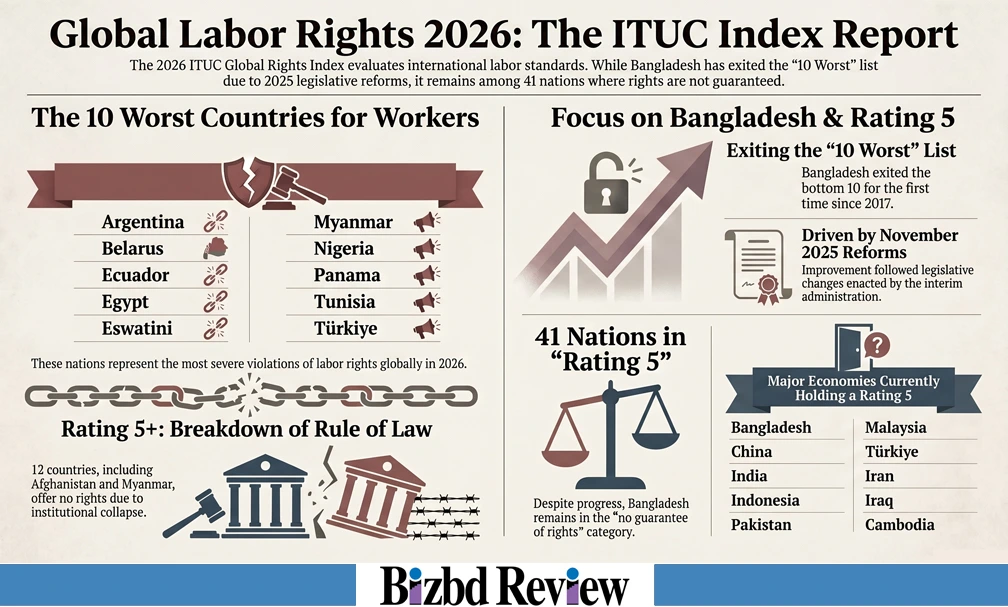
Bangladesh has moved out of the list of the world’s 10 worst countries for workers’ rights in 2026 for the first time since 2017, although the country remained in rating 5, ‘no guarantee of rights’, in the latest International Trade Union Confederation Global Rights Index.
Bangladesh had featured among the world’s 10 worst countries for working people until the 2025 edition of the index, marking the ninth consecutive year the country was placed in the lowest rating category.
The ITUC report, published on Monday, said Bangladesh’s improvement was largely driven by legislative reforms enacted in November 2025 under the interim administration led by Muhammad Yunus after the fall of the previous Sheikh Hasina government in 2024.
According to the index, the reforms significantly reduced barriers to trade union formation by allowing unions to be established with the support of as few as 20 workers, replacing the previous requirement for approval from 20 per cent of a company’s total workforce.
The reforms also introduced 120 days of paid maternity leave, expanded social security, welfare and union rights to domestic and agricultural workers, and brought the hazardous shipbreaking industry under formal labour regulations for the first time.
Bangladesh Institute of Labour Studies executive director Syed Sultan Uddin Ahmmed described Bangladesh’s removal from the list of the 10 worst countries for workers as a positive development, saying that recent labour law reforms had introduced several constructive measures.
However, he said effective implementation would require the removal of existing administrative obstacles.
Sultan Uddin said that trade union registration remained difficult in small and medium-sized factories, as establishments employing 50 workers still require 40 per cent representation to form a union.
He also stressed the need to extend legal protection to all categories of workers and ensure genuine trade union representation in tripartite committees.
Despite describing the reforms as historic breakthroughs, the ITUC said workers in Bangladesh continued to face serious obstacles in exercising fundamental labour rights.
The report noted that freedom of association remained heavily restricted because of regulatory barriers and strong resistance from employers.
Workers in Special Economic Zones were still systematically deprived of their right to form and join trade unions, it said.
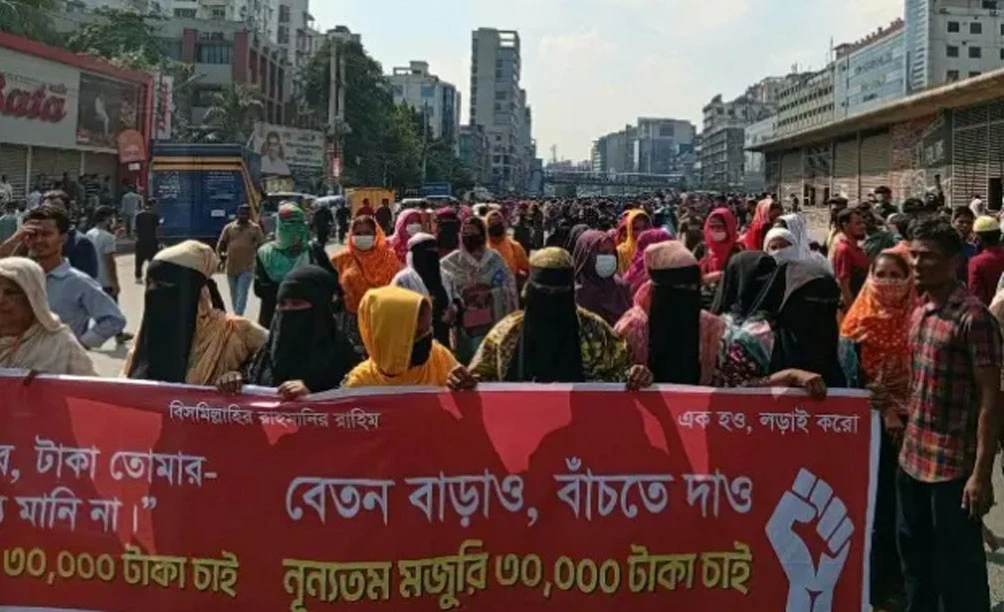
The ITUC also highlighted continued repression of labour protests and strikes through police action and legal restrictions.
It referred to an incident in April 2025 when workers from Apparel Plus EC Limited, TNZ Apparels Ltd and Apparel Art Ltd staged demonstrations outside the labour ministry over months of unpaid wages and festival allowances.
Police and labour authorities dispersed the protest using tear gas, leaving numerous workers injured.
The 13th edition of the annual index assessed workers’ rights protections in law and practice across 152 countries, ranking them in categories from 1 to 5+, with 1 representing the strongest protection of collective labour rights and 5+ the worst category.
According to the ITUC, countries placed in Rating 5 are considered among the worst places in the world for workers because, although some rights may formally exist in national legislation, workers effectively have little or no access to them and remain exposed to unfair labour practices.
The report said 41 countries, including Bangladesh, Cambodia, China, India, Indonesia, Iran, Iraq, Malaysia, Pakistan and Türkiye, were assigned rating 5 in 2026.
The 10 worst countries for workers in the 2026 index were identified as Argentina, Belarus, Ecuador, Egypt, Eswatini, Myanmar, Nigeria, Panama, Tunisia and Türkiye.
According to the ITUC, these countries were marked by severe state repression, arbitrary arrests and the suppression of independent labour organising.
The report also identified 12 countries in the harsher rating 5+ category, defined as ‘no guarantee of rights due to the breakdown of the rule of law’.
These included Afghanistan, Myanmar, Libya, Palestine, Syria, Yemen, Burundi, the Central African Republic, Somalia, South Sudan and Sudan.
According to the ITUC, countries in the 5+ category suffer from dysfunctional institutions caused by armed conflict, political instability or military occupation, leaving workers with virtually no legal protection.
The report observed that labour conditions deteriorated across several regions in 2026.
Europe and the Americas recorded their worst average scores since the index began in 2014, largely due to the rise of far-right politics and authoritarian leadership.
The Middle East and North Africa remained the world’s most oppressive region for workers, with all 19 countries in the region violating rights related to union registration, collective bargaining and labour organising.
In the Asia-Pacific region, the ITUC said governments in Hong Kong, Myanmar and Cambodia continued to jail or exile labour leaders and suppress independent dissent.
Globally, the report found that the right to strike was violated in 87 per cent of countries, while the right to collective bargaining was restricted in 80 per cent and the right to form and join trade unions violated in 75 per cent of countries.
The ITUC additionally highlighted the vulnerability of Bangladeshi migrant workers abroad, particularly in the Middle East and North Africa region.
It noted that Bangladeshi migrant workers had been killed in attacks linked to the ongoing conflict involving Israel and Iran, while many faced language barriers and legal discrimination that limited their ability to seek safety or evacuate during periods of unrest.
‘The 2026 Global Rights Index shows that the crisis for workers’ rights is no longer confined to the margins – it is now at the heart of democracies,’ ITUC General Secretary Luc Triangle said in a statement.
He said that governments were failing to protect working people and, in many cases, were actively undermining them.