1:19 am, Thursday, 16 April 2026

Bangladesh ushers in Bengali New Year with festive celebrations

Pahela Baishakh, the first day of the Bengali New Year, was celebrated across Bangladesh on Tuesday with traditional festivities, cultural programmes and widespread public participation, marking a renewal of hope, unity and heritage.

In Dhaka, the annual Ananda Shobhajatra, organised by the Faculty of Fine Arts at Dhaka University, began at 9:06am from in front of the campus and concluded at around 10:05am after passing through Shahbagh, TSC, Raju Memorial Sculpture, Doyel Chattar and surrounding areas.

This year’s procession carried the theme ‘Nababarsher Oikkyotan, Gonotontrer Punorutthan’ (Unity of the New Year, Revival of Democracy), featuring elaborate masks, motifs and a 150-page potchitro reflecting cultural identity and social messages.

The event was held under extensive security arrangements, with horse-mounted police leading the procession, followed by units from the Detective Branch, SWAT, Rapid Action Battalion and a bomb disposal team. Student groups, Rover Scouts and university personnel also joined the march.

Dhaka University Vice-Chancellor Professor A S M Obaidul Islam led the procession, accompanied by Cultural Affairs Minister Nitai Roy Chowdhury, senior university officials and faculty members.

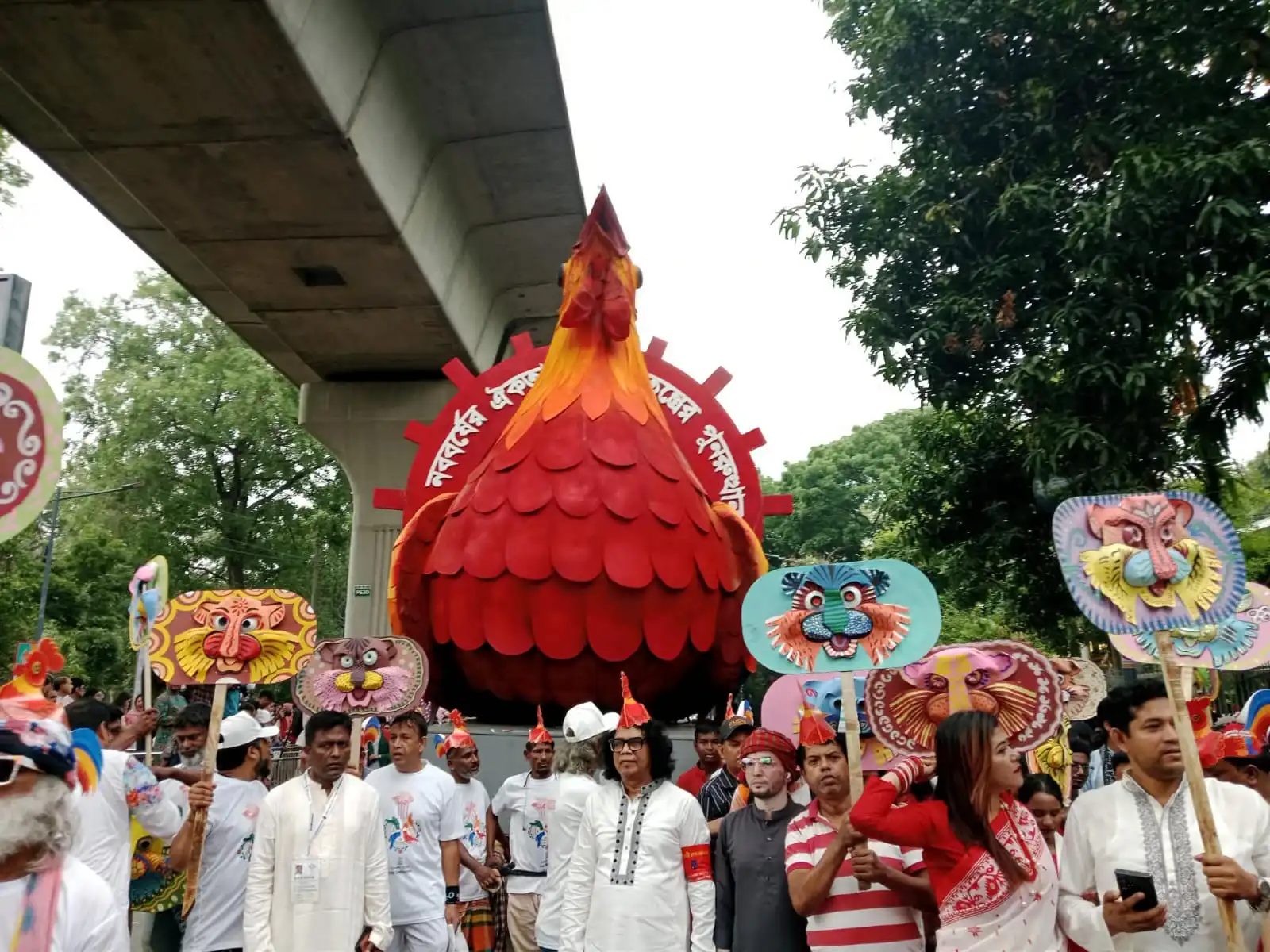
Five principal motifs formed the highlight of this year’s Shobhajatra—a rooster, elephant, pigeon, dotara and horse—each symbolising aspects of Bengali culture and tradition.

The rooster, topped with a rising sun motif, represented awakening and renewal. The dotara reflected the nation’s folk musical heritage, while also drawing attention to the recognition of traditional musicians.

The wooden elephant, inspired by folk craftsmanship from Narayanganj, symbolised strength and heritage.

The horse evoked rural life and childhood memories, while the pigeon conveyed messages of peace and coexistence.

A large rooster installation briefly became stuck while passing beneath the metro rail near TSC, drawing cheers from spectators after it was successfully manoeuvred through.

Elsewhere in the capital, crowds gathered at Ramna Batamul at dawn, where the iconic song ‘Esho He Boishakh’ was performed in chorus, setting the tone for the day’s celebrations.

Across Dhaka and other parts of the country, people dressed in red and white took part in cultural programmes, music and traditional festivities, ushering in the Bengali New Year with enthusiasm and colour.


Tag :

Bangladesh ushers in Bengali New Year with festive celebrations

Update Time : 01:50:08 pm, Tuesday, 14 April 2026

Pahela Baishakh, the first day of the Bengali New Year, was celebrated across Bangladesh on Tuesday with traditional festivities, cultural programmes and widespread public participation, marking a renewal of hope, unity and heritage.

In Dhaka, the annual Ananda Shobhajatra, organised by the Faculty of Fine Arts at Dhaka University, began at 9:06am from in front of the campus and concluded at around 10:05am after passing through Shahbagh, TSC, Raju Memorial Sculpture, Doyel Chattar and surrounding areas.

This year’s procession carried the theme ‘Nababarsher Oikkyotan, Gonotontrer Punorutthan’ (Unity of the New Year, Revival of Democracy), featuring elaborate masks, motifs and a 150-page potchitro reflecting cultural identity and social messages.

The event was held under extensive security arrangements, with horse-mounted police leading the procession, followed by units from the Detective Branch, SWAT, Rapid Action Battalion and a bomb disposal team. Student groups, Rover Scouts and university personnel also joined the march.

Dhaka University Vice-Chancellor Professor A S M Obaidul Islam led the procession, accompanied by Cultural Affairs Minister Nitai Roy Chowdhury, senior university officials and faculty members.

Five principal motifs formed the highlight of this year’s Shobhajatra—a rooster, elephant, pigeon, dotara and horse—each symbolising aspects of Bengali culture and tradition.

The rooster, topped with a rising sun motif, represented awakening and renewal. The dotara reflected the nation’s folk musical heritage, while also drawing attention to the recognition of traditional musicians.

The wooden elephant, inspired by folk craftsmanship from Narayanganj, symbolised strength and heritage.

The horse evoked rural life and childhood memories, while the pigeon conveyed messages of peace and coexistence.

A large rooster installation briefly became stuck while passing beneath the metro rail near TSC, drawing cheers from spectators after it was successfully manoeuvred through.

Elsewhere in the capital, crowds gathered at Ramna Batamul at dawn, where the iconic song ‘Esho He Boishakh’ was performed in chorus, setting the tone for the day’s celebrations.

Across Dhaka and other parts of the country, people dressed in red and white took part in cultural programmes, music and traditional festivities, ushering in the Bengali New Year with enthusiasm and colour.