Bizbd Report
New research presented at a conference in Dhaka has confirmed that unionisation delivers a significant wage premium for factory workers, with unionised employees across the readymade garment sector earning 10 per cent higher gross wages than their non-unionised counterparts.
The findings, shared at the Annual BIDS Conference on Development 2025, also highlighted the impressive productivity gains and technological transformation underway in Bangladesh’s RMG industry.
The study, titled ‘Wage earnings of manufacturing workers in Bangladesh: Do trade union matter?’, surveyed 3,005 workers across 20 industries in three districts near Dhaka.
It established an overall unionisation rate of 11.35 per cent among the surveyed workforce.
Mahmudul Hasan, a research associate at the Bangladesh Institute of Development Studies (BIDS), explained that the 10 per cent wage advantage for union members remains statistically significant even after controlling for factors such as greater experience and tenure.
Crucially, the study showed that workers in the RMG sector, which is the country’s largest export earner, earn a statistically significant 19 to 22 per cent higher wage compared to employees in other manufacturing industries.
This strong sectoral advantage is attributed to the RMG industry’s formalised structures, higher skill intensity, and robust compliance regimes.
Hasan pointed out an interesting dynamic within the RMG industry itself, noting that the union wage coefficient was not statistically significant.
He said that this indicated there was no measurable wage difference between unionised and non-unionised RMG workers once observable characteristics and industry-level compliance were taken into account.
hassan suggested that this occurs because unions generate a generalised wage premium across the entire manufacturing base, with the relatively higher wages in the RMG sector reflecting spillover effects of union activity.
In effect, union advocacy for higher wages benefits both members and non-members alike within the sector, thus eliminating the internal wage differential while widening the gap between RMG and other manufacturing.
Hasan stressed that the results underscore the vital importance of collective bargaining and the enforcement of wage standards.
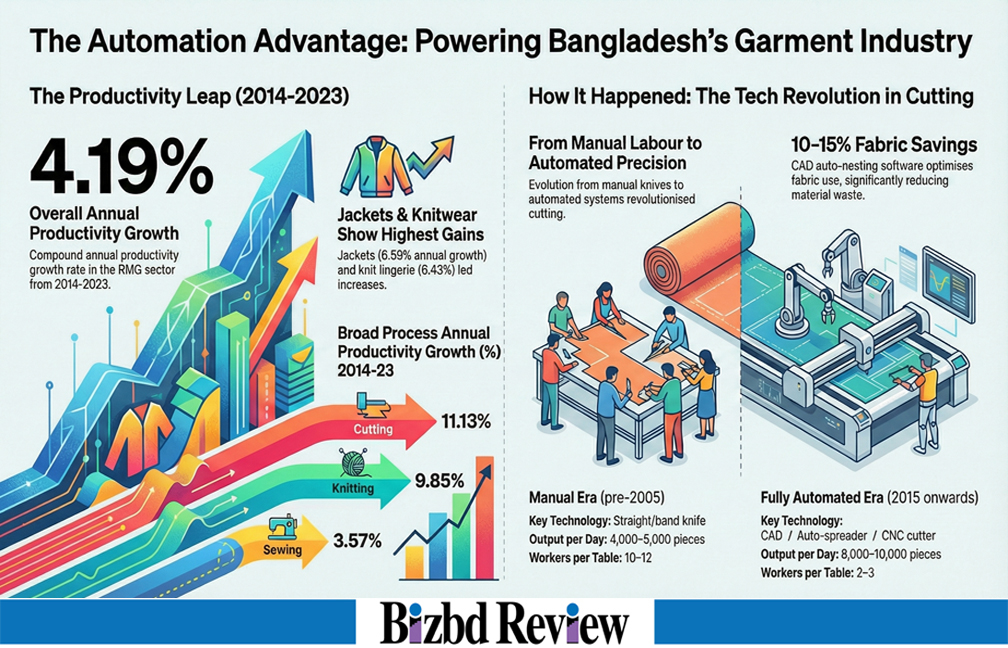
A separate study, ‘Technological changes at the process and sub-process level in the RMG industry in Bangladesh’, revealed that the RMG sector has experienced approximately 4.19 per cent annual growth in productivity over the last ten years since 2014.
Productivity was measured as output per unit of time at the task level.
The productivity surge was highest for certain key items: jackets recorded the greatest average annual growth at 6.59 per cent, followed by knit lingerie (6.43 per cent), sweaters (6.05 per cent), home textiles (5.58 per cent), and t-shirts (4.39 per cent).
BIDS research associate Kazi Zubair Hossain shared the findings, noting that while the RMG industry’s modernisation began in the early 2000s, the subsequent two decades have been characterised by a strong drive towards automation and a firm commitment to sustainability, including the adoption of energy and water-saving technology.
The research, which examined 51 RMG firms, showed clear indications of technological convergence between large and medium-scale companies.
Sophisticated technologies previously limited to large firms—such as automated cutting, semi-automatic sewing heads, laser/ozone finishing, and digital QC tools—are now becoming widespread in medium-scale operations.
Zubair said that the study also showed convergence in capital-labour ratios, which has strong implications for industrial policy and local capacity building in manufacturing capital goods.
During the conference, BIDS senior research fellow Mohammad Harunur Rashid Bhuyan highlighted ongoing challenges in ensuring decent work for the country’s garment workers.
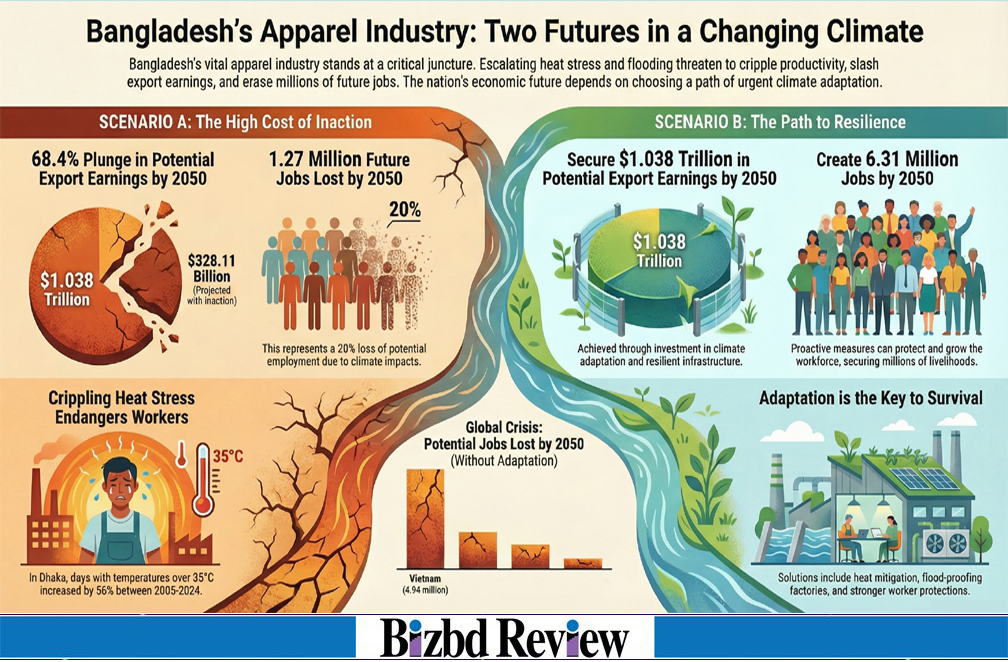
He cautioned that rising temperatures inside factories pose serious health risks and reduce productivity. Furthermore, the increasing numbers of climate refugees entering the workforce could potentially exert downward pressure on wages.
Harun recommended policies that prioritise decent work, support economic upgrading, and expand access to renewable, green energy to ensure sustainable development across the industry.
The third session of the annual conference, where these crucial findings were presented, was moderated by BIDS researcher Mohammad Yunus.