1:45 am, Tuesday, 4 August 2026

RMG slowdown drags Bangladesh’s July exports down 0.9pc

Bangladesh’s merchandise export earnings declined marginally in July, the first month of the financial year 2026-27, as weaker shipments from the country’s dominant readymade garment sector outweighed robust growth in several non-traditional export sectors.

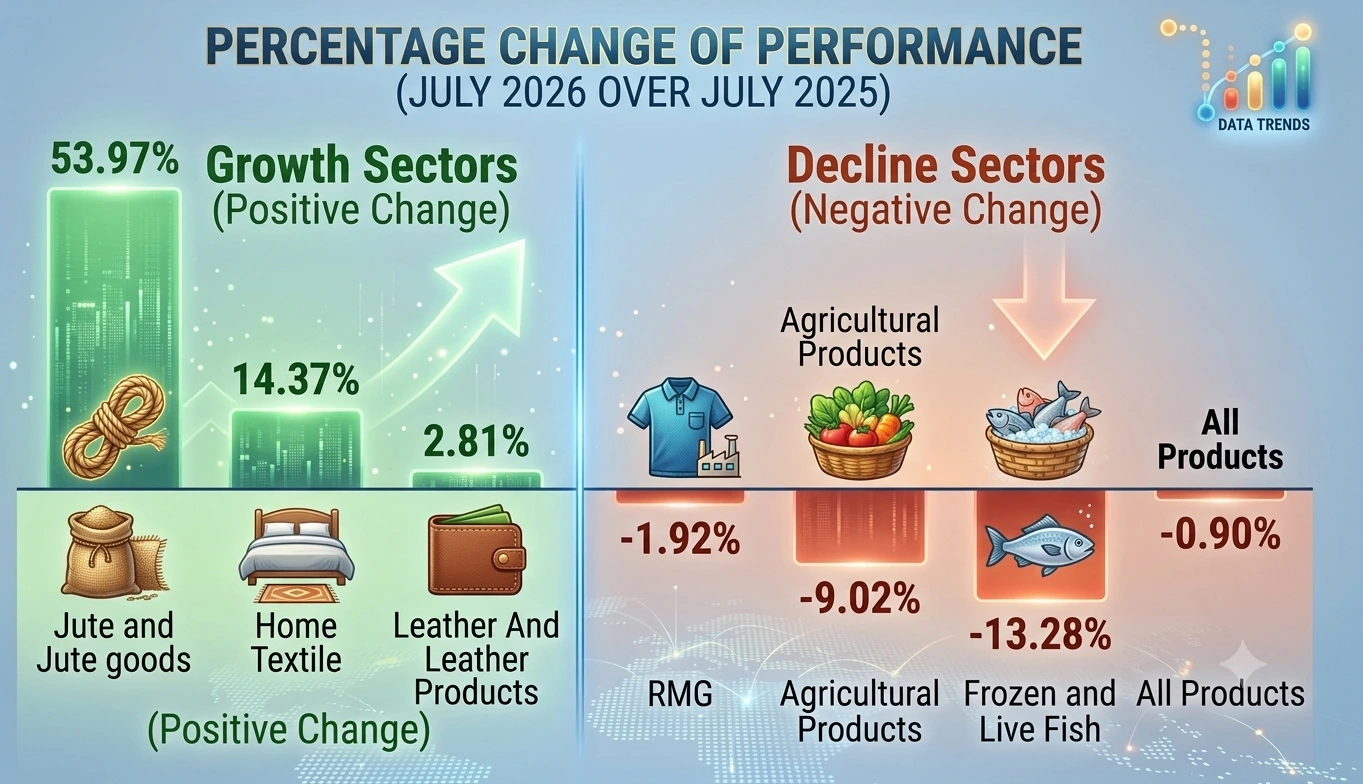
Data released by the Export Promotion Bureau on August 3 showed that the country’s exports fell by 0.9 per cent year on year to $4.73 billion in July from $4.77 billion in the corresponding month of the previous year.

The decline was mainly driven by the readymade garment sector, which accounts for more than four-fifths of the country’s export earnings.

RMG exports fell by 1.92 per cent to $3.89 billion from $3.96 billion a year earlier, reducing the sector’s contribution to total exports to about 82.2 per cent.

Knitwear exports slipped by 0.9 per cent to $2.16 billion, while woven garment exports recorded a steeper 3.16 per cent decline to $1.73 billion.

Despite the weakness in apparel exports, a number of non-apparel sectors posted strong growth, cushioning the overall decline in export earnings.

Jute and jute goods emerged as the best-performing sector, with exports surging by 53.97 per cent to $85.36 million from $55.44 million a year earlier.

Home textile exports rose by 14.37 per cent to $77.86 million, while engineering products increased by 18.62 per cent to $69.07 million.

Bicycle exports, a major engineering product, climbed by 20.54 per cent to $14.61 million.

Chemical products also recorded strong growth, with exports rising by 25.68 per cent to $41.36 million.

Pharmaceutical exports, a key component of the sector, increased by 19 per cent to $22.67 million.

Leather and leather products registered modest growth of 2.81 per cent, with export earnings reaching $130.96 million compared with $127.38 million in July last year.

Within the sector, leather products rose by 5.48 per cent to $40.43 million, although leather footwear exports declined by 2.76 per cent to $77.62 million.

Plastic product exports also edged up by 1.98 per cent to $21.58 million.

Several traditional export sectors, however, remained under pressure.

Agricultural product exports declined by 9.02 per cent to $82.34 million, while exports of frozen and live fish dropped by 13.28 per cent to $35.73 million.

Shrimp exports recorded the sharpest fall among the major product groups, plunging by 22.83 per cent to $24.10 million from $31.23 million a year earlier.

The United States retained its position as Bangladesh’s largest export destination in July, with shipments rising marginally by 0.25 per cent to $918.74 million.

Germany remained the second-largest market with imports worth $495.30 million, followed by the United Kingdom at $478.42 million.

Among the major export destinations, India recorded the fastest growth at 15.3 per cent, followed by Saudi Arabia with a 10.64 per cent increase.

The July trade data suggest that Bangladesh began the new financial year with subdued export momentum as the contraction in garment shipments offset gains in non-traditional sectors.

However, strong performances by jute and jute goods, home textiles, engineering products and pharmaceuticals helped limit the overall decline in export earnings.
RMG slowdown drags Bangladesh’s July exports down 0.9pc

Update Time : 06:26:16 pm, Monday, 3 August 2026

Bangladesh’s merchandise export earnings declined marginally in July, the first month of the financial year 2026-27, as weaker shipments from the country’s dominant readymade garment sector outweighed robust growth in several non-traditional export sectors.

Data released by the Export Promotion Bureau on August 3 showed that the country’s exports fell by 0.9 per cent year on year to $4.73 billion in July from $4.77 billion in the corresponding month of the previous year.

The decline was mainly driven by the readymade garment sector, which accounts for more than four-fifths of the country’s export earnings.

RMG exports fell by 1.92 per cent to $3.89 billion from $3.96 billion a year earlier, reducing the sector’s contribution to total exports to about 82.2 per cent.

Knitwear exports slipped by 0.9 per cent to $2.16 billion, while woven garment exports recorded a steeper 3.16 per cent decline to $1.73 billion.

Despite the weakness in apparel exports, a number of non-apparel sectors posted strong growth, cushioning the overall decline in export earnings.

Jute and jute goods emerged as the best-performing sector, with exports surging by 53.97 per cent to $85.36 million from $55.44 million a year earlier.

Home textile exports rose by 14.37 per cent to $77.86 million, while engineering products increased by 18.62 per cent to $69.07 million.

Bicycle exports, a major engineering product, climbed by 20.54 per cent to $14.61 million.

Chemical products also recorded strong growth, with exports rising by 25.68 per cent to $41.36 million.

Pharmaceutical exports, a key component of the sector, increased by 19 per cent to $22.67 million.

Leather and leather products registered modest growth of 2.81 per cent, with export earnings reaching $130.96 million compared with $127.38 million in July last year.

Within the sector, leather products rose by 5.48 per cent to $40.43 million, although leather footwear exports declined by 2.76 per cent to $77.62 million.

Plastic product exports also edged up by 1.98 per cent to $21.58 million.

Several traditional export sectors, however, remained under pressure.

Agricultural product exports declined by 9.02 per cent to $82.34 million, while exports of frozen and live fish dropped by 13.28 per cent to $35.73 million.

Shrimp exports recorded the sharpest fall among the major product groups, plunging by 22.83 per cent to $24.10 million from $31.23 million a year earlier.

The United States retained its position as Bangladesh’s largest export destination in July, with shipments rising marginally by 0.25 per cent to $918.74 million.

Germany remained the second-largest market with imports worth $495.30 million, followed by the United Kingdom at $478.42 million.

Among the major export destinations, India recorded the fastest growth at 15.3 per cent, followed by Saudi Arabia with a 10.64 per cent increase.

The July trade data suggest that Bangladesh began the new financial year with subdued export momentum as the contraction in garment shipments offset gains in non-traditional sectors.

However, strong performances by jute and jute goods, home textiles, engineering products and pharmaceuticals helped limit the overall decline in export earnings.