11:23 pm, Friday, 5 December 2025
ECONOMIST RAZZAQUE SAYS

Bangladesh needs MMF, premium apparel to compete globally

Research and Policy Integration for Development (RAPID) chairman Mohammad Abdur Razzaque. -File Photo.

Bangladesh, the world’s second-largest garment exporter, must accelerate diversification into man-made fibre (MMF) and higher-value products if it is to expand its global market share, which has remained largely stagnant despite China’s shrinking dominance, according to Mohammad Abdur Razzaque, chairman of Research and Policy Integration for Development (RAPID).

The economist recently told Bizbd Review that, although China had lost more than nine percentage points of market share over the past decade, Bangladesh had been unable to capture a significant portion of it.

Razzaque said that much of the gain in the United States had gone to Vietnam, while Bangladesh had performed better in the European Union, benefiting mainly from duty-free access.

In contrast, he observed that Bangladesh had made little headway in penetrating China’s $10 billion domestic apparel market, where Vietnam and Cambodia were the key players.

Razzaque emphasised that Bangladesh needed to build capacity in MMF-based products, where it remained weak despite performing strongly in cotton garments.

He siad that diversification into high-value and niche categories, such as outdoor sportswear, premium womenswear, party suits and high-end jackets, was crucial, and stressed the importance of forging stronger ties with global brands known for design-intensive production, an area still dominated by China.

Razzaque warned that investment in MMF production faced structural barriers, including high capital costs, limited access to bank credit amid inflation and high interest rates, a shallow capital market, scarce foreign direct investment, and the energy-intensive nature of production.

He said that persistent energy security issues—particularly unreliable electricity and gas supply—further discouraged large-scale investment.

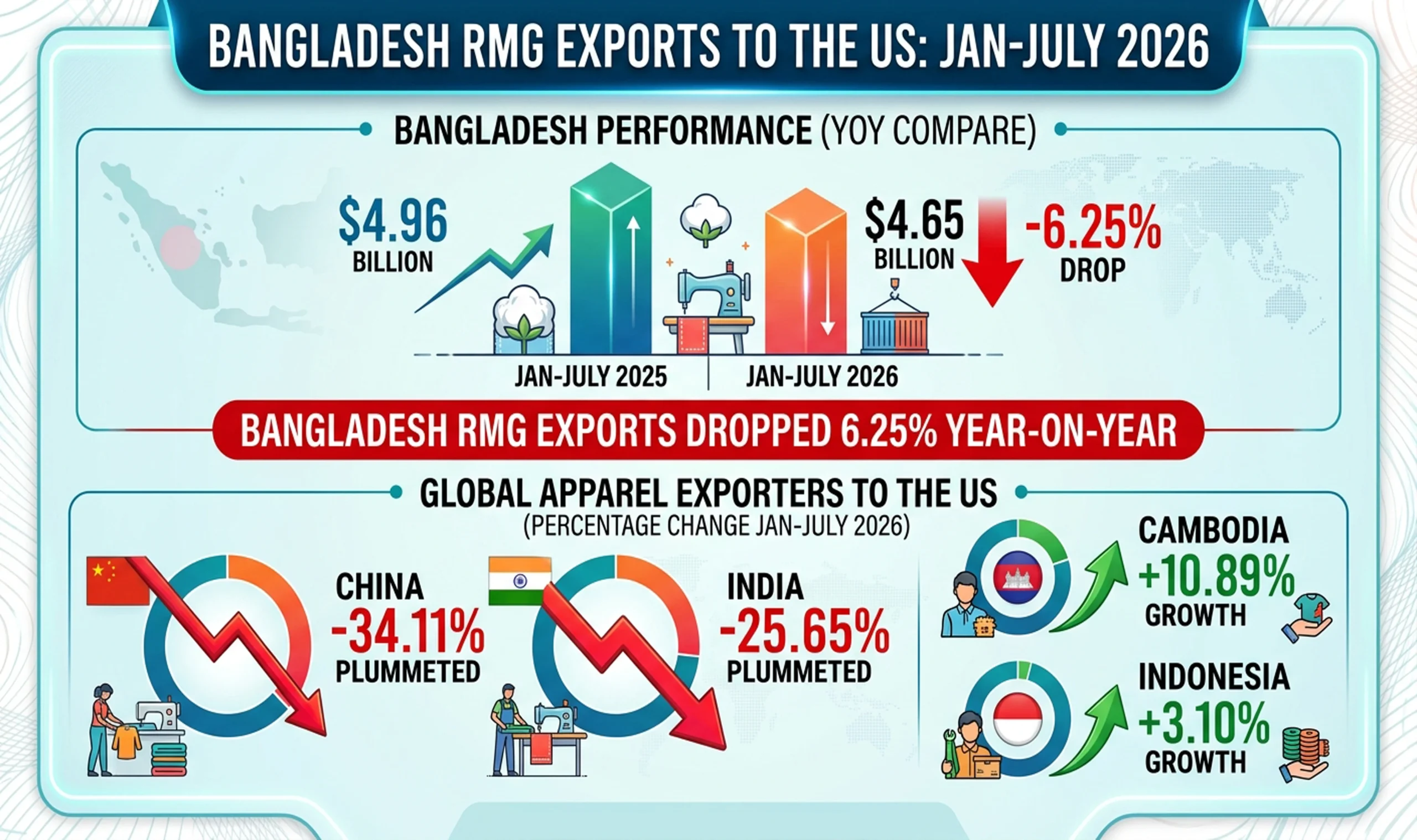
On trade policy, the economist highlighted the rising tariff burden in the US, where duties on Bangladesh’s exports had increased from 15 per cent to 35 per cent.

Although Bangladesh enjoyed slightly more favourable terms than India and China, he said that meeting the requirement of 40 per cent domestic value addition to qualify for a 20 per cent tariff remained challenging, particularly for woven and MMF products, and warned that failure to meet the threshold could expose exporters to the full 35 per cent rate.

Razzaque cautioned that as access to the US market became more difficult, global suppliers were likely to pivot towards the EU, intensifying competition and potentially pushing down prices.

He added that without bold steps to diversify products and invest in man-made fibre capacity, Bangladesh risked losing ground in the global apparel trade despite its current position.
ECONOMIST RAZZAQUE SAYS

Bangladesh needs MMF, premium apparel to compete globally

Update Time : 08:42:01 pm, Monday, 18 August 2025

Bangladesh, the world’s second-largest garment exporter, must accelerate diversification into man-made fibre (MMF) and higher-value products if it is to expand its global market share, which has remained largely stagnant despite China’s shrinking dominance, according to Mohammad Abdur Razzaque, chairman of Research and Policy Integration for Development (RAPID).

The economist recently told Bizbd Review that, although China had lost more than nine percentage points of market share over the past decade, Bangladesh had been unable to capture a significant portion of it.

Razzaque said that much of the gain in the United States had gone to Vietnam, while Bangladesh had performed better in the European Union, benefiting mainly from duty-free access.

In contrast, he observed that Bangladesh had made little headway in penetrating China’s $10 billion domestic apparel market, where Vietnam and Cambodia were the key players.

Razzaque emphasised that Bangladesh needed to build capacity in MMF-based products, where it remained weak despite performing strongly in cotton garments.

He siad that diversification into high-value and niche categories, such as outdoor sportswear, premium womenswear, party suits and high-end jackets, was crucial, and stressed the importance of forging stronger ties with global brands known for design-intensive production, an area still dominated by China.

Razzaque warned that investment in MMF production faced structural barriers, including high capital costs, limited access to bank credit amid inflation and high interest rates, a shallow capital market, scarce foreign direct investment, and the energy-intensive nature of production.

He said that persistent energy security issues—particularly unreliable electricity and gas supply—further discouraged large-scale investment.

On trade policy, the economist highlighted the rising tariff burden in the US, where duties on Bangladesh’s exports had increased from 15 per cent to 35 per cent.

Although Bangladesh enjoyed slightly more favourable terms than India and China, he said that meeting the requirement of 40 per cent domestic value addition to qualify for a 20 per cent tariff remained challenging, particularly for woven and MMF products, and warned that failure to meet the threshold could expose exporters to the full 35 per cent rate.

Razzaque cautioned that as access to the US market became more difficult, global suppliers were likely to pivot towards the EU, intensifying competition and potentially pushing down prices.

He added that without bold steps to diversify products and invest in man-made fibre capacity, Bangladesh risked losing ground in the global apparel trade despite its current position.