Bizbd Report
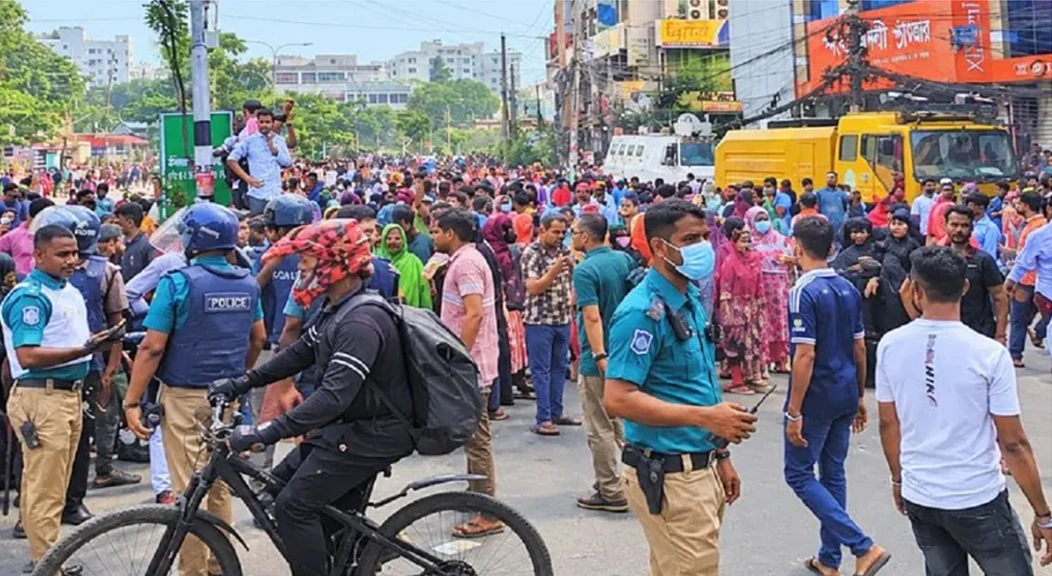
Readymade garment workers continued protests and road blockades in Dhaka and its outskirts on November 1, demanding a minimum monthly wage of Tk 30,000 and payment of outstanding wages, disrupting traffic and forcing many factories to suspend operations.
In the capital, several hundred workers from different garment factories took to the streets in Mirpur for the second consecutive day, blocking roads at Mirpur 10, 11 and 12 and the Proshika intersection.
The protests began around 9:00am at the Mirpur 10 roundabout and gradually spread to nearby areas, bringing traffic to a standstill and causing severe congestion. Commuters travelling through the areas faced considerable difficulties.
Additional police were deployed at the protest sites to maintain law and order.
The protests also forced most garment factories in Mirpur to declare a holiday for the day, although some attempted to resume operations after lunch but failed, said Hosna Akter, a worker at Purabi Garment Factory.
Meanwhile, at least 30 garment factories in Ashulia and Gazipur declared holidays on Saturday after hundreds of workers came out of their factories demanding a minimum monthly wage of Tk 30,000 and payment of outstanding wages, despite repeated government calls to refrain from demonstrations.
Industrial Police additional inspector general Gazi Jasim Uddin said that five factories in Gazipur and 25 in Ashulia had declared holidays by around 11:00am on Saturday after workers from several factories joined the protests.
In Ashulia, demonstrations by workers from several factories, including Nayem Knitwear in the Kathgora area, led to the closure of factories.
He said that protesters threw bricks at several nearby factories at one stage, triggering a chase and counter-chase between workers and police. Three law enforcement personnel were injured in the incident.
In Gazipur, garment workers blocked the Dhaka-Tangail Highway in the Palli Bidyut area of Chandra in Kaliakair, halting traffic on the busy route. The blockade was removed about an hour later, he added.
Meanwhile, the government reiterated that it would issue a gazette notification on Sunday to form a wage board for the garment industry to review workers’ wages.
The announcement came after a meeting between Labour Minister Ariful Hoque Choudhury and leaders of the Bangladesh Garment Manufacturers and Exporters Association and the Bangladesh Knitwear Manufacturers and Exporters Association at Sram Bhaban in Dhaka on Saturday.
Speaking at a press briefing after the meeting, the minister said there was no valid reason for garment workers to continue street demonstrations as the government had already taken steps to address their main demands.
He said that a decision to form a wage board, with representation from workers, had been reached following four hours of discussions with worker representatives on Friday.
The minister also said that steps were being taken to clear outstanding wage arrears by the seventh working day of each month, adding that further agitation was therefore unjustified.
He alleged that vested political interests were exploiting labour-related grievances to create instability in the industrial sector and destabilise the government. He urged the media and law enforcement agencies to identify outsiders allegedly instigating violence.
Warning that prolonged factory closures and vandalism would hurt exports and undermine the sector’s ability to pay workers on time, he called for an end to the unrest.
BKMEA president Mohammad Hatem, meanwhile, said factory owners would have no alternative but to close their units under Section 13(1) of the Labour Act if protests and disruptions continued.