Bizbd Report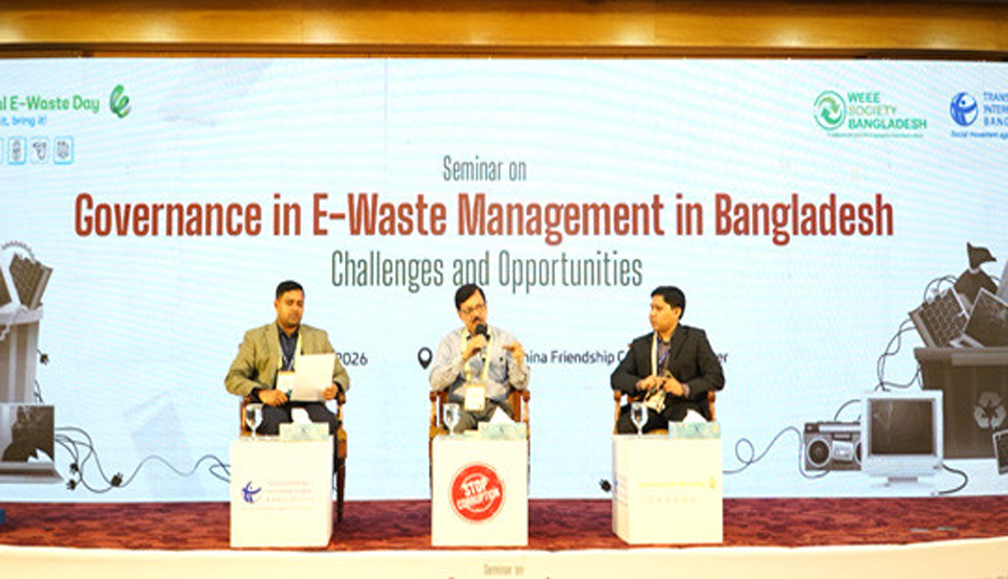
Old electronic equipment and electronic waste continue to enter Bangladesh despite legal restrictions and import bans, posing severe environmental risks, speakers at a seminar in Dhaka said on Wednesday.
Data presented at the seminar showed that about 14,985 tonnes of e-waste components, valued at $0.7 million, were imported between 2022 and 2024 across sectors including textile and garment, commerce, and engineering.
Transparency International Bangladesh (TIB) and WEEE Society Bangladesh organised the seminar, Governance in E-Waste Management in Bangladesh: Challenges and Opportunities, at the Bangladesh China Friendship Conference Centre.
Abdullah Zahid Osmani, TIB research associate (environment and climate finance), presented the data.
Citing the import policy and hazardous waste management rules, Osmani said bringing in reconditioned office equipment, old computers and general waste is strictly banned.
Citing a TIB study published in December last year, he said the absence of effective product-identification mechanisms allows these illegal imports to go unchecked.
Speakers said about 97 per cent of the country’s e-waste is collected informally, while only 3 per cent is formally recycled and exported.
They said rapid technological growth has led to a surge in e-waste, including mobile devices, office automation equipment, vehicle batteries and abandoned electronic voting machines (EVMs).
Iqbal Ahmed, a commissioner of the Bangladesh Telecommunication Regulatory Commission (BTRC), said formal recycling handles only about 3 per cent of e-waste, although the actual volume of discarded electronics is significantly higher.
Beyond environmental and physical safety concerns, he said, digital data security is a major vulnerability because no certified authorities ensure that discarded devices are completely cleared of private information.
Saimum Parvez, special assistant to the prime minister on environment, forest and climate change, said at the opening session that environmental protection and climate action remain core state priorities.
He said the government was actively transitioning from fossil fuel-based economic models to renewable energy systems, integrating tree-plantation targets and implementing sustainable waste management policies.
Iftekharuzzaman, executive director of TIB, spoke on governance deficits in the sector.
‘The core indicators of good governance — such as transparency, accountability and inclusivity — are glaringly absent in current e-waste policies, which remain fragmented and poorly implemented,’ he said.
‘We lack comprehensive data inventories and standardised tracking systems for e-waste, a challenge compounded by millions of discarded devices and abandoned electronic voting machines across districts,’ he said, adding that rigorous regulatory enforcement was urgently needed.
Sumon Ahmed Sabir, chairman of WEEE Society Bangladesh, said informal recycling networks dominate the sector.
‘Over 90 per cent of e-waste collection is driven by informal operators who lack health safety standards, making formal institutional integration and public awareness vital for sustainable management,’ he said.
Speakers said coordinated action was needed to address regulatory gaps, ensure strict compliance and build formal infrastructure to manage the escalating e-waste crisis.
Aligning state initiatives with robust private-sector cooperation and stringent compliance mechanisms, they said, would be essential to turning the challenge into a sustainable green economy.
Three panel discussions were held, on enforcement progress of the hazardous waste management rules 2021, e-waste management in the telecom industry and e-waste management in the ship recycling industry.