Bizbd Report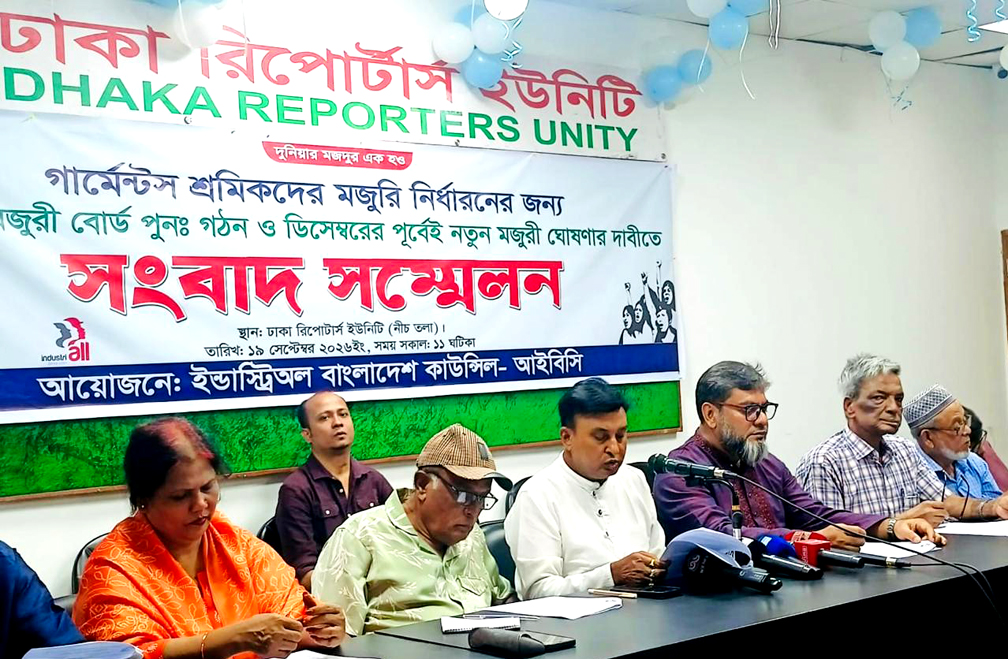
IndustriALL Bangladesh Council on Saturday demanded immediate reconstitution of the minimum wage board for the garment sector and completion of a new minimum wage determination by November 30, saying the new wage must take effect from December.
At a press conference at the Dhaka Reporters Unity, IBC general secretary Salauddin Swapan said the government should reconstitute the wage board by September 30, determine the new minimum wage by November 30 and implement the revised wage from December 2026.
Workers should receive the revised wage with their December salary in the first week of January, he said.
The IBC also announced a series of programmes to press home its demands, including a rally in front of the National Press Club at 11:00am on October 4, followed by a procession to submit a memorandum to the labour minister.
It will also organise rallies and protest processions through its regional committees in Gazipur, Savar-Ashulia, Narayanganj and Chattogram between October 5 and 20.
Swapon said the Bangladesh Labour Act originally provided for the minimum wage of workers to be reviewed every five years.
The amended law in 2026 reduced the interval to three years under section 139(6), taking into account the cost of living, inflation, productivity and the country’s economic situation.
The latest minimum wage for garment workers was announced in November 2023, meaning the three-year period will expire in November this year.
He said the wage board should have been reconstituted by the first week of May if the new wage was to be determined by November, as the law requires the board to submit its wage proposal to the government within six months of its formation.
‘But no visible initiative has yet been taken to reconstitute the wage board,’ Swapon said.
The IBC had written to the labour minister on August 4 demanding immediate reconstitution of the board, but the government had yet to take any initiative, he said.
The organisation said the delay had created uncertainty over the timely determination and implementation of a new wage for garment workers.
Swapon also referred to the government’s recently announced National Pay Scale 2026, under which salaries of government employees have been raised by 100 to 142 per cent depending on grades.
He said the salary for employees in the lowest, 20th grade had been raised from Tk 20,010 to Tk 48,400.
He argued that the increase in government salaries, alongside rising prices of essential commodities, house rents and medical expenses, had widened the income gap between government employees and low-paid garment workers.
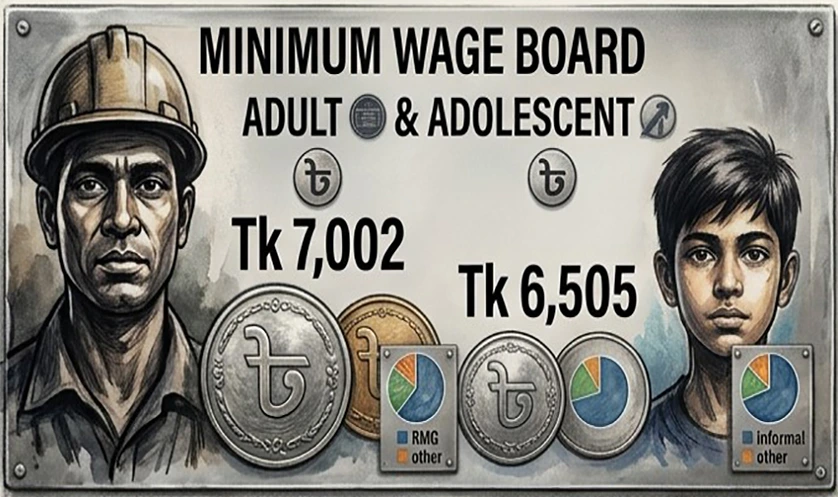
The IBC said the minimum wage in the garment sector had risen from Tk 1,662.50 in 2006 to Tk 3,000 in 2010, Tk 5,300 in 2013, Tk 8,000 in 2018 and Tk 12,500 in 2023.
The labour organisation claimed that the increase in nominal wages had not kept pace with the rising cost of living, leaving many workers struggling to meet basic household expenses.
It also criticised garment factory owners for seeking government financial support at times of difficulty while, according to the IBC, showing less willingness to improve workers’ wages and benefits.
The IBC represents 19 Bangladeshi trade union organisations affiliated with IndustriALL Global Union, according to the organisation.
Of the 19 federations, 16 work with garment workers, two with chemical-sector workers and one with metal-sector workers, Swapon said.
IBC president Mir Abul Kalam Azad, senior vice-president Amirul Haque Amin, vice-president China Rahman, and leaders including Kutub Uddin Ahmed, Ruhul Amin, Babul Akter, Nurul Islam, Shahidullah Badal, Khadiza Rahman, Kaisarun Nabi Rubel, Khadiza Akter, Tamiza Sultana and Hasan Ali were present at the press conference.
Meanwhile, Bangladesh Garment Manufacturers and Exporters Association president Mahmud Hasan Khan on Thursday said the amended law had reduced the interval for reviewing the minimum wage from five years to three years, but there were differences over when the three-year period should begin.
He said the industry body believed the period should start after the previous five-year term ended, which would put the next review in 2028, while other interpretations suggested 2029 or retrospective application from 2023.
He said the labour ministry was working on the issue and holding informal discussions with stakeholders, who wanted to resolve the matter through dialogue while considering the industry’s capacity, workers’ living standards and Bangladesh’s international competitiveness.