4:20 am, Monday, 25 May 2026

Over 3,700 factories fail to pay festival allowances on time

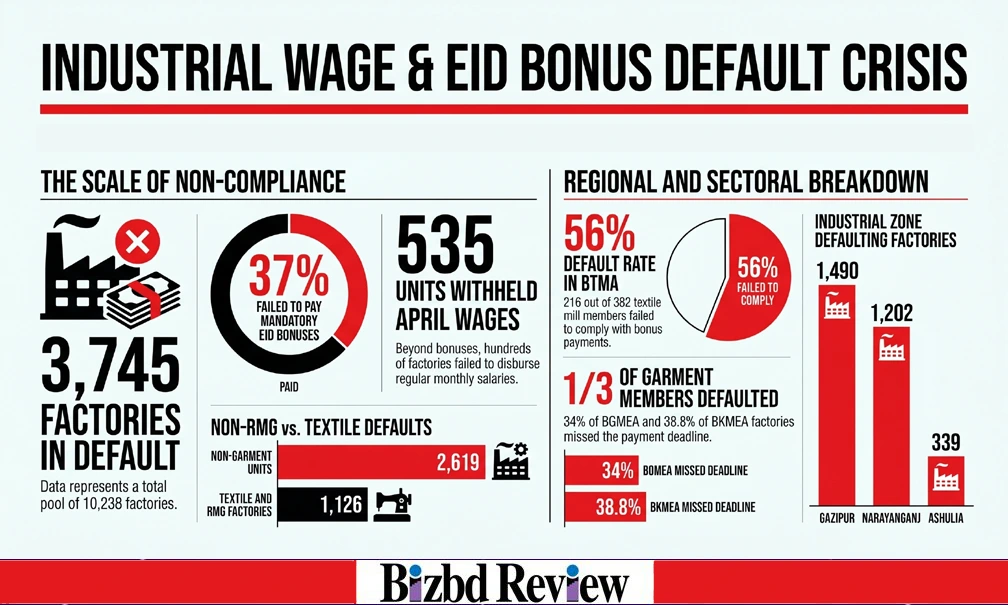
Approximately 3,745 factories, including more than 1,100 garment units, have failed to pay legally required Eid-ul-Azha bonuses, with hundreds also withholding April wages, according to Bangladesh Industrial Police data.

More than a third of factories overseen by Bangladesh’s Industrial Police (IP) had still not paid mandatory festival allowances as of May 24, flouting a government deadline of May 21 and raising fears of industrial unrest on the eve of Eid-ul-Azha.

Eid-ul-Azha, one of the largest religious festivals for Muslims, will be celebrated on May 28.

According to IP figures, 3,745 out of 10,238 factories– some 37 per cent– operating across eight industrial zones had not disbursed the customary Eid bonus by the close of Sunday (May 24).

The non-compliant units comprised 1,126 textile and readymade garment (RMG) factories and 2,619 non-RMG establishments.

In a separate but related concern, more than 535 factories, including 155 textile and garment units, had also withheld workers’ wages for April, leaving employees without pay before the holiday commences.

The IP has jurisdiction over factories in Ashulia, Gazipur, Chattogram, Narayanganj, Mymensingh, Khulna, Cumilla, and Sylhet — all zones outside Dhaka Metropolitan City.

Of the industrial zones monitored, Gazipur recorded the highest number of non-compliant factories at 1,490, followed by Narayanganj with 1,202, Ashulia with 339, and Chattogram with 311.

The shortfall also extends to trade association members.

Within the Bangladesh Garment Manufacturers and Exporters Association (BGMEA), 619 factories or 34 per cent of its 1,790 listed members had not paid.

Among the 708 factories registered with the Bangladesh Knitwear Manufacturers and Exporters Association (BKMEA), 275 units, or 38.84 per cent, remained in default.

Some 216 members of the Bangladesh Textile Mills Association (BTMA), out of 382, had similarly not complied.

Sixteen factories operating under the Bangladesh Export Processing Zones Authority (BEPZA) had also failed to make the festival payment.

Labour Minister Ariful Haque Chowdhury had convened a meeting on May 14 at which factory owners were expressly directed to settle festival allowances by May 21 and to honour monthly wage obligations in accordance with Bangladesh’s labour law.

The instruction was issued explicitly to forestall any industrial unrest during the Eid holiday period.

At the same meeting, trade union leaders urged the government to take direct action against factory managements in arrears, warning that delays in wages and bonuses could destabilise labour relations at a sensitive time of year.

In a separate development, the government recently disbursed Tk 15 billion as the fourth tranche of export subsidies for the financial 2025-26, covering 43 export-oriented sectors.

The cash incentive programme supports key industries including readymade garments, frozen fish, leather goods, and jute products, with rates ranging from 0.30 per cent to 10 per cent depending on the category of exported goods.
Over 3,700 factories fail to pay festival allowances on time

Update Time : 12:25:33 am, Monday, 25 May 2026

Approximately 3,745 factories, including more than 1,100 garment units, have failed to pay legally required Eid-ul-Azha bonuses, with hundreds also withholding April wages, according to Bangladesh Industrial Police data.

More than a third of factories overseen by Bangladesh’s Industrial Police (IP) had still not paid mandatory festival allowances as of May 24, flouting a government deadline of May 21 and raising fears of industrial unrest on the eve of Eid-ul-Azha.

Eid-ul-Azha, one of the largest religious festivals for Muslims, will be celebrated on May 28.

According to IP figures, 3,745 out of 10,238 factories– some 37 per cent– operating across eight industrial zones had not disbursed the customary Eid bonus by the close of Sunday (May 24).

The non-compliant units comprised 1,126 textile and readymade garment (RMG) factories and 2,619 non-RMG establishments.

In a separate but related concern, more than 535 factories, including 155 textile and garment units, had also withheld workers’ wages for April, leaving employees without pay before the holiday commences.

The IP has jurisdiction over factories in Ashulia, Gazipur, Chattogram, Narayanganj, Mymensingh, Khulna, Cumilla, and Sylhet — all zones outside Dhaka Metropolitan City.

Of the industrial zones monitored, Gazipur recorded the highest number of non-compliant factories at 1,490, followed by Narayanganj with 1,202, Ashulia with 339, and Chattogram with 311.

The shortfall also extends to trade association members.

Within the Bangladesh Garment Manufacturers and Exporters Association (BGMEA), 619 factories or 34 per cent of its 1,790 listed members had not paid.

Among the 708 factories registered with the Bangladesh Knitwear Manufacturers and Exporters Association (BKMEA), 275 units, or 38.84 per cent, remained in default.

Some 216 members of the Bangladesh Textile Mills Association (BTMA), out of 382, had similarly not complied.

Sixteen factories operating under the Bangladesh Export Processing Zones Authority (BEPZA) had also failed to make the festival payment.

Labour Minister Ariful Haque Chowdhury had convened a meeting on May 14 at which factory owners were expressly directed to settle festival allowances by May 21 and to honour monthly wage obligations in accordance with Bangladesh’s labour law.

The instruction was issued explicitly to forestall any industrial unrest during the Eid holiday period.

At the same meeting, trade union leaders urged the government to take direct action against factory managements in arrears, warning that delays in wages and bonuses could destabilise labour relations at a sensitive time of year.

In a separate development, the government recently disbursed Tk 15 billion as the fourth tranche of export subsidies for the financial 2025-26, covering 43 export-oriented sectors.

The cash incentive programme supports key industries including readymade garments, frozen fish, leather goods, and jute products, with rates ranging from 0.30 per cent to 10 per cent depending on the category of exported goods.