Bizbd Report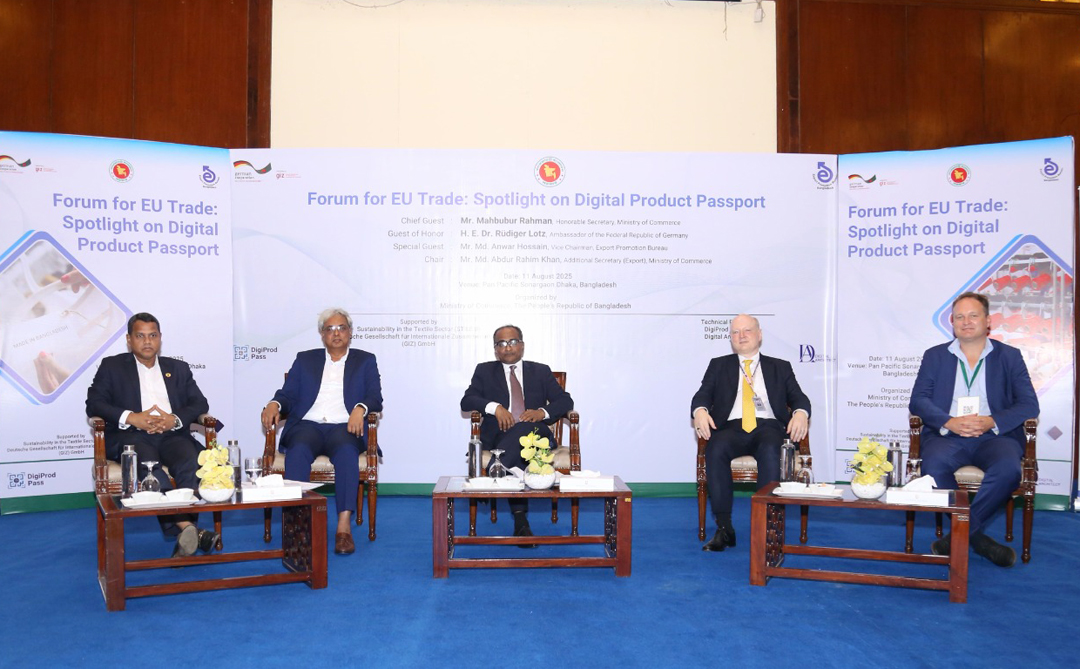
Lack of awareness about circular supply chains, recent EU regulations, and digitalisation—especially among small and medium factories—is hindering Bangladesh’s ability to ensure traceability of export goods, industry experts warned at a seminar held in Dhaka on Monday.
Speaking at a seminar titled ‘EU Trade Forum: Spotlight on the Digital Product Passport’ held on Monday in Dhaka, Abdul Quaium, Sustainability Manager at Italian fashion brand OVS, said that many suppliers are unfamiliar with the concept of traceability and circular supply chain practices.
‘Most of our suppliers don’t know what traceability is, while many lack awareness of supply chain circularity,’ Quaium said.
He said that there was limited knowledge of recent EU regulations, including the Ecodesign for Sustainable Products Regulation (ESPR) and the Digital Product Passport (DPP), which were vital for aligning exports with EU sustainability standards.
The day-long seminar was jointly organised by the Ministry of Commerce and the German development agency GIZ to raise awareness of the DPP and to assess Bangladesh’s readiness to comply with the EU’s ESPR.
Quaium explained that the DPP, a mandatory electronic record under the EU Green Deal legislation, tracked information throughout a product’s lifecycle.
It covered data on labels, certifications, carbon footprint, supply chain due diligence, materials, resource efficiency, and durability, thereby promoting circular economy principles and sustainability.
He said that OVS had been working for the past four to five years to reduce both pre- and post-consumer waste and to establish a circular supply chain with product traceability and transparency.
However, Quaium said many suppliers continued to sell garment waste—known locally as jhut—without proper traceability.
He mentioned that this was the main challenge for them in gathering accurate data because they wanted to achieve a circular supply chain. He also stated that segregating garment waste by colour could reduce recycling costs by at least 30 per cent.
Vidya Amrit Khan, Vice President of the Bangladesh Garment Manufacturers and Exporters Association (BGMEA), said that some factories, including DBL, Square, and Urmi Group, had already implemented the DPP system.
However, she expressed concern that factories were facing audit fatigue from continuously adapting to new regulations while simultaneously managing new projects.
Vidya emphasised that they did not want to be non-compliant or lag behind, but also did not want audit fatigue, calling for a unified approach so all brands and buyers adhered to a single mandatory standard.
The seminar, moderated by Michael Klode, Head of the STILE II project of GIZ, aimed to provide detailed insights into EU traceability requirements and the circular economy.
Speakers discussed the technical framework of the DPP and its potential to ensure end-to-end traceability—from raw materials to finished products.
Minhazul Hoque, Director of the Bangladesh Knitwear Manufacturers and Exporters Association (BKMEA), stressed the importance of shifting entrepreneurs’ mindsets towards investing in the right digital tools and technologies to achieve maximum benefit.
Commerce Secretary Mahbubur Rahman, the chief guest at the opening session, highlighted the EU’s critical role as a market for Bangladesh and urged preparations to adopt the DPP concept to ensure product sustainability and identity.
He said that this was the first technology-driven event of its kind organised in Bangladesh, while cautioning that implementing regulations like the DPP should avoid excessive cost burdens.
German Ambassador to Bangladesh, Rüdiger Lotz, described the DPP as an important tool for maintaining product traceability and transparency.
Additional Secretary of the Commerce Ministry, Abdur Rahim Khan, acknowledged the necessity of the DPP to comply with the EU Green Deal and meet buyer demands, but stressed the importance of synchronising the system so that the burden would be shared fairly among all stakeholders, including buyers.
He added that the government was ready to provide policy support once the specific needs of the industry were identified.
Export Promotion Bureau Vice Chairman Anwar Hossain said they wanted to develop a data ecosystem for the DPP that would remain under government ownership, enabling exporters, factory owners, and other private sector entities to benefit.
He further urged the creation of a supportive policy framework to help small and medium enterprises (SMEs) onboard the digital process, highlighting that SMEs were currently lagging behind in establishing a digital footprint.