Bizbd Report
Bangladesh’s merchandise exports grew by 6.34 per cent year-on-year to $13.09 billion in the first quarter of the financial year 2026-27, driven mainly by readymade garment shipments, although the September growth partly reflected a low base and continued challenges facing the apparel industry.
The country earned $13.09 billion during July-September, compared with $12.31 billion in the corresponding period of FY26, an increase of about $781 million, according to Export Promotion Bureau data released on October 1.
September exports rose 8.54 per cent to $3,937.23 million from $3,627.58 million a year earlier.
Readymade garment exports increased by 6.10 per cent to $10,578.56 million from $9,970.42 million, accounting for about 80.8 per cent of total export earnings.
The sector contributed approximately $608 million, or nearly 78 per cent, of the overall increase in exports during the quarter.
Knitwear exports rose 6.88 per cent to $5.96 billion from $5.58 billion, while woven garment shipments increased 5.11 per cent to $4.61 billion from $4.39 billion.
Knitwear accounted for around 45.5 per cent of total exports.
Despite the positive quarterly figures, Bangladesh Garment Manufacturers and Exporters Association president Mahmud Hasan Khan cautioned against interpreting September’s growth as evidence of a strong recovery in the apparel sector, attributing much of the increase to the low base of September 2025.
He said RMG exports in September 2025 had fallen to $2.84 billion, mainly because of the impact of US tariffs introduced in August that year and continuing into September.
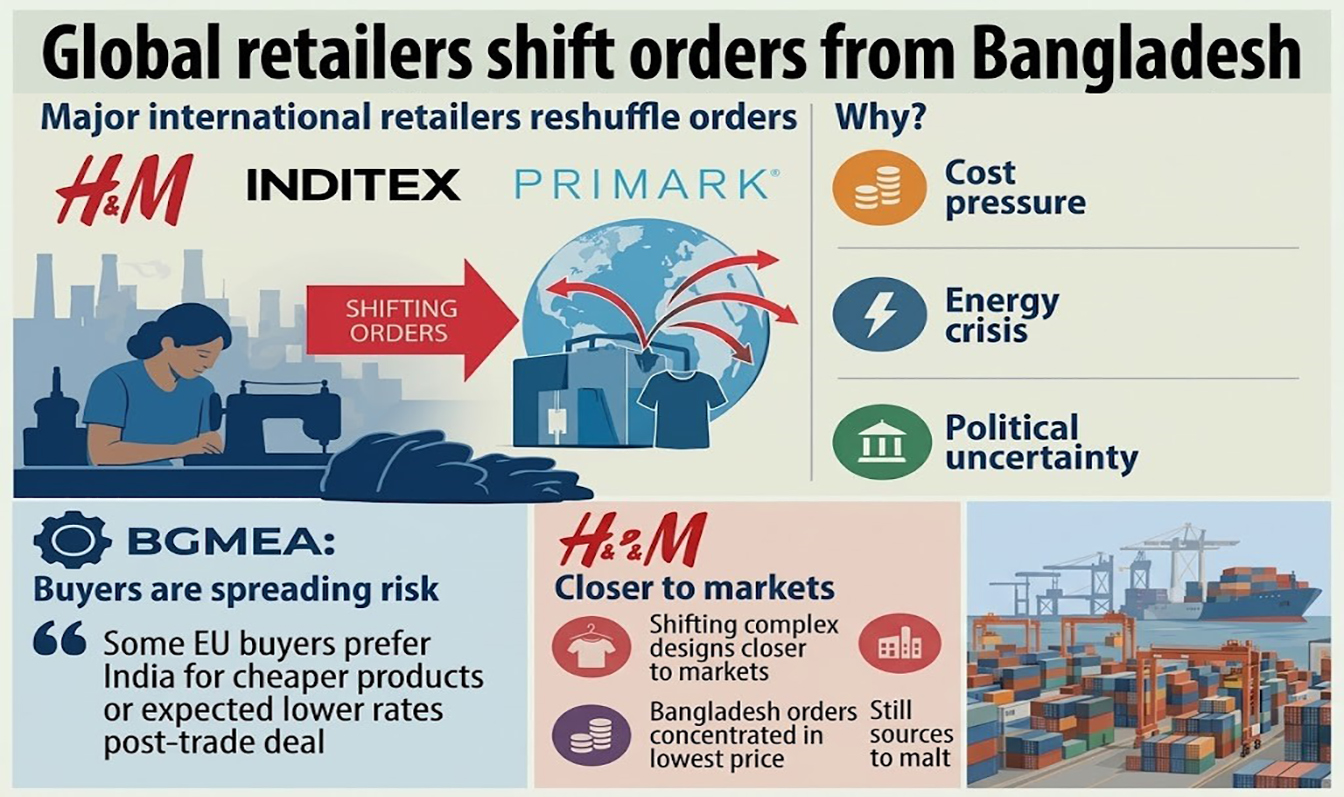
Bangladesh had also experienced a significant decline in exports to the European Union during that period, as China began dominating the EU market following the US tariff measures, he said.
Mahmud Hasan Khan also pointed to an overall upward trend in cotton prices earlier in 2026, driven by tight global supplies, as another factor behind the relatively low level of exports.
He noted that the September RMG export figure of around $3 billion was approximately 10 per cent below Bangladesh’s average monthly garment export earnings, reflecting continuing difficulties in the industry.
The 8.56 per cent year-on-year growth in September should therefore not be interpreted as a sign of absolute growth, and the sector’s actual performance required careful assessment, he said.
While garments continued to dominate export earnings, several non-RMG sectors recorded stronger growth rates during the quarter, indicating some expansion in Bangladesh’s export base.
Jute and jute goods posted the highest growth among the major sectors, with earnings increasing 31.55 per cent to $253.75 million from $192.89 million.
The sector added about $61 million to export earnings and maintained its momentum in September, when shipments grew 22.72 per cent.
Leather and leather products exports in July-September of FY27 rose 14.74 per cent to $366.88 million from $319.74 million.
Within the sector, leather footwear earnings increased 12.45 per cent to $208.72 million, leather products grew 16.42 per cent to $119.59 million, and leather exports rose 22.80 per cent to $38.57 million.
Other footwear exports increased 17 per cent to $152.13 million in the first quarter, while engineering products grew 16.51 per cent to $192.67 million. Home textile exports rose 11.94 per cent to $231.29 million.
September shipments also recorded notable gains in leather footwear, other footwear, leather and leather products, jute and home textiles, which grew 22.90 per cent, 21.30 per cent, 20.19 per cent, 22.72 per cent and 13.52 per cent respectively.
However, agricultural products and fish exports contracted during the quarter, offsetting part of the gains in other sectors.
Agricultural exports, excluding tobacco, fell 13.74 per cent to $238.57 million, a decline of about $38 million, while September shipments dropped 21.70 per cent.
Frozen and live fish exports in the first quarter of the FY27 declined 10.27 per cent to $113.17 million from $126.12 million in the FY 26, with September earnings falling 10.30 per cent.
Vegetable exports decreased 6.90 per cent to $24.01 million, although shipments edged up 1.42 per cent in September.
Plastic product exports also declined 2.04 per cent to $70.18 million during the quarter, despite returning to modest growth of 1.67 per cent in September.
Non-RMG exports earned approximately $2.52 billion during July-September, up around 7.4 per cent from $2.34 billion in the same period of FY26.
Among Bangladesh’s export destinations, the United States remained the largest market, with shipments increasing 11.34 per cent to $2.59 billion in the first quarter of FY27 from $2,327.77 million in the corresponding period of the previous financial year.
The United Kingdom ranked second, with exports worth $1.37 billion, followed by Germany at $1.22 billion.
Türkiye recorded the highest growth among major export destinations, with shipments more than doubling, rising 100.11 per cent to $210.54 million from $105.21 million.
India and Japan also remained important export destinations, ranking sixth and ninth respectively among Bangladesh’s major markets, with both recording positive growth.
The quarterly figures showed that Bangladesh’s export earnings increased by about $781 million, with garments accounting for nearly four-fifths of the gain.