Bizbd Report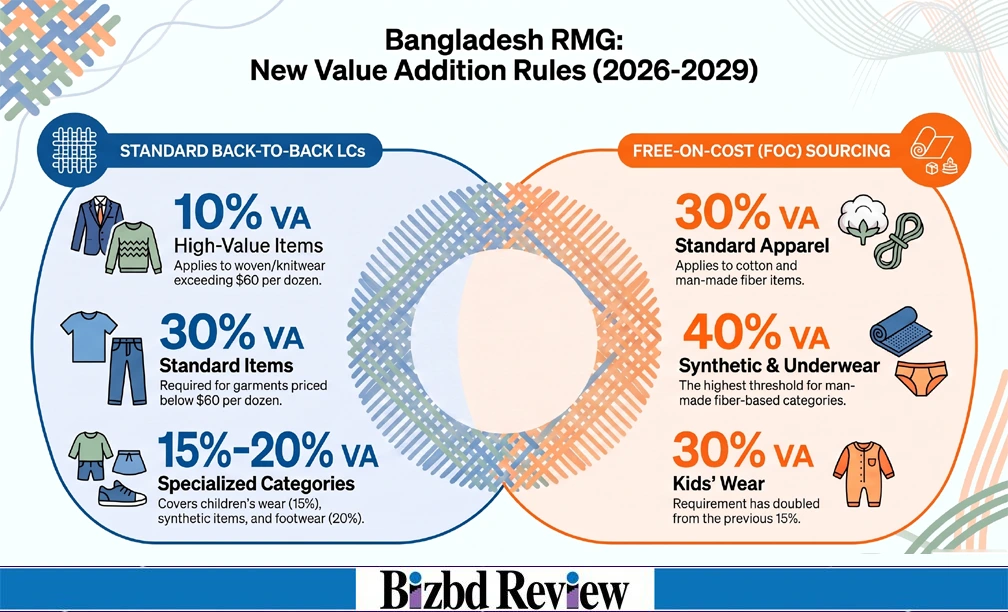
The government has tightened value addition requirements for garment exports to as much as 40 per cent under the new import policy, in a move aimed at reducing reliance on imported raw materials, strengthening local backward linkage industries and curbing trade-based money laundering.
According to the Import Policy Order 2026-2029, gazetted on August 24 by the commerce ministry, the government has set structured value addition benchmarks for the garment and textile sector, fixing minimum retention thresholds ranging between 10 per cent and 40 per cent depending on product valuation, category and sourcing method.
To encourage high-value apparel manufacturing, the policy retains the reduced 10 per cent value addition requirement, unchanged, for woven and knitwear items with a free-on-board (FOB) price exceeding $60 per dozen under standard back-to-back letters of credit (LCs).
This compares with a 30 per cent requirement for garments priced below that threshold.
Previously, the threshold stood at 20 per cent for woven and knitwear items with an FOB price below $60 per dozen.
Children’s wear will require a minimum 15 per cent value addition under regular LCs, while underwear and synthetic fibre items will carry a baseline of 20 per cent.
For raw materials imported on a free-of-cost (FOC) basis, a uniform 30 per cent value addition will apply across standard apparel — both knit and woven, made from cotton as well as man-made fibre — while the threshold has been raised to 40 per cent for synthetic and underwear categories.
Meanwhile, the minimum value addition requirement for kids’ wear under the FOC system has been doubled to 30 per cent, from 15 per cent previously.
For footwear, leather goods, non-leather footwear and bags, shipbuilding, furniture, and aluminium foil (of 5.3 to 6 micron thickness) per kilogramme, the value addition requirement under standard back-to-back LCs has been set at 20 per cent, and at 30 per cent under the FOC system– except for furniture, which has been fixed at 50 per cent.
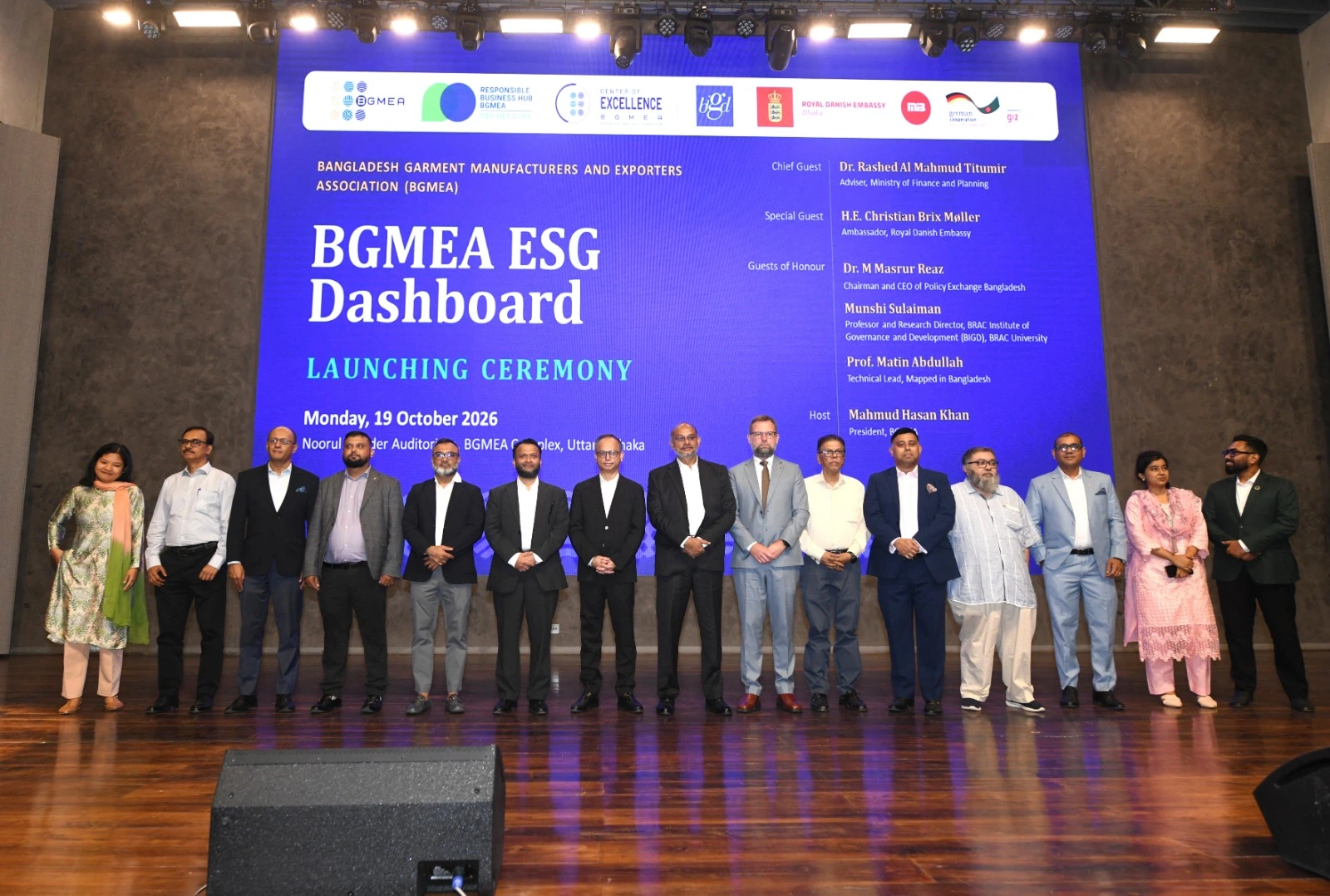
Responding to the changes, Bangladesh Garment Manufacturers and Exporters Association (BGMEA) president Mahmud Hasan Khan said the three trade bodies representing the textile and garment sector — BGMEA, the Bangladesh Knitwear Manufacturers and Exporters Association (BKMEA), and the Bangladesh Textile Mills Association (BTMA) — had agreed on a 30 per cent value addition requirement.
A higher value addition threshold, he said, would help increase the use of local raw materials and support the growth of backward linkage industries in the country.
SM Khaled, managing director of Snowtex Group, said the 30 per cent value addition requirement would not pose a significant challenge for cotton-based garment production. However, he said the threshold could prove difficult for man-made fibre (MMF)-based garment manufacturing unless uninterrupted utility supply, particularly gas, was ensured, noting that the backward linkage base for MMF was not yet sufficiently developed.
Fazlul Hoque, managing director of Plummy Fashions Ltd, said the threshold for the FOC system should be relaxed, pointing out that buyers supply fabric to manufacturers at their own cost under this arrangement.
As a result, he said, there was less risk of issues such as order cancellations, price discounts or costly air shipments.
He added that a 30 per cent value addition requirement might not be feasible for manufacturers who predominantly produce basic items in large volumes at relatively low prices.
BKMEA president Mohammad Hatem criticised the government for fixing a 40 per cent value addition requirement for undergarments and synthetic fabric-based garments, saying the specific rate had not been discussed with stakeholders beforehand.
He questioned the rationale for differentiating between the standard LC and FOC systems, arguing there should be no distinction between the two.
‘The FOC system is more secure, and there is no possibility of export proceeds not being realised,’ he said, explaining that closed or partially closed factories with already classified loans could bring in raw materials under the FOC system and still earn foreign currency.
He added that this particular provision of the policy ran counter to the government’s own stated aim of reopening closed factories.