Bizbd Report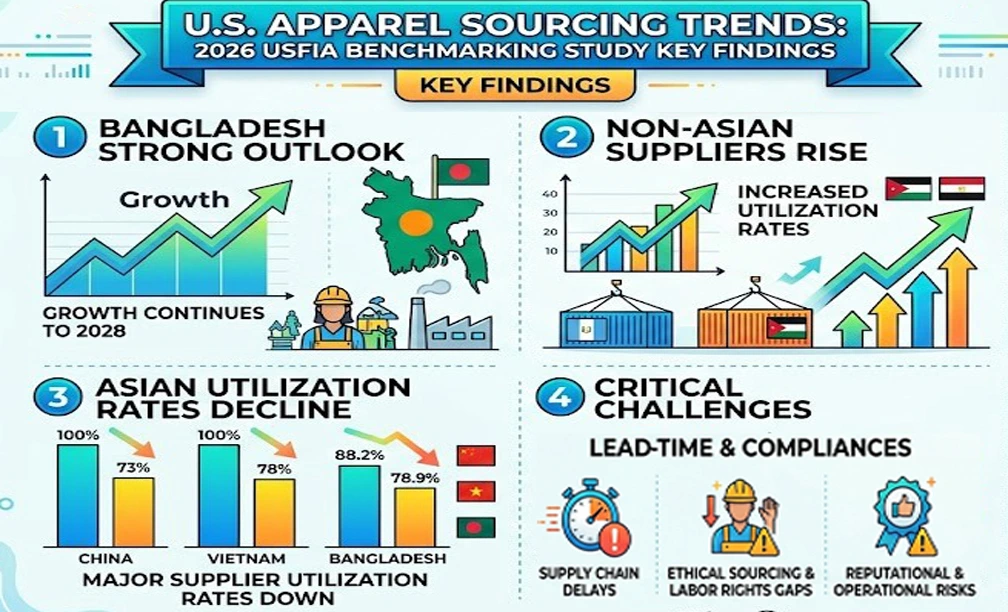
Bangladesh’s position as a leading global apparel sourcing destination weakened in 2026 as its utilisation rate among US fashion companies declined amid a shift towards supplier consolidation and more balanced sourcing strategies.
The country retained its strong cost competitiveness and surpassed China in the US apparel import market for the first time, but continued to trail key competitors in speed to market, order flexibility and labour and environmental compliance.
According to the 2026 USFIA Benchmarking Study, jointly conducted by the United States Fashion Industry Association and the University of Delaware, were released on Monday, Bangladesh’s utilisation rate dropped to 78.9 per cent in 2026 from 88.2 per cent a year earlier.
Utilisation rate refers to the frequency with which a sourcing destination was used divided by the total number of survey respondents.
The report said that Bangladesh had tied with Vietnam, Cambodia, and Indonesia as the most-utilised apparel sourcing destination in 2026 based on the utilisation rate.
However, it said, utilisation rates among the major Asian sourcing destinations had declined compared to the 2025 survey.
China’s utilisation rate fell from 100 per cent to 73 per cent, while Vietnam’s dropped from 100 per cent to about 78 per cent.
The report, however, emphasised that the decline in Bangladesh’s utilisation rate should not be interpreted as a loss of competitiveness.
Instead, it said, the decline reflected a broader transformation in global sourcing strategies.
According to the report, US brands identified president Trump’s protectionist trade policies as their biggest business challenge in 2026, prompting companies to reduce their sourcing exposure to countries considered most vulnerable to future trade restrictions, particularly China and Vietnam.
Meanwhile, three non-Asian countries – Guatemala, Egypt, and Jordan – climbed to the top 10 sourcing destinations in 2026, with all of them recording higher utilisation rates than a year earlier.
According to the report, protectionist US trade policies and tariff-related uncertainties remained the fashion industry’s biggest business challenge in 2026, with 92 per cent of the surveyed companies identifying them as their primary concern.
It said that the average applied US tariff on apparel imports had increased to 21.6 per cent in May 2026 from 15.2 per cent before the start of President Donald Trump’s second term.
The report also found that China and Vietnam were perceived to face the highest risk from future US import trade barriers, while Bangladesh, India, and Cambodia were considered to face moderate risk.
In contrast, suppliers in seven CAFTA-DR member countries – USA, Costa Rica, Dominican Republic, El Salvador, Guatemala, Honduras, and Nicaragua – and US domestic manufacturers were viewed as the least exposed to potential new trade restrictions.
The survey for the 2026 Fashion Industry Benchmarking Study was carried out between April and June 2026 and covered 30 leading US fashion companies.
Bangladesh, the report also said, achieved a historic milestone by surpassing China in the US apparel market for the first time in decades.
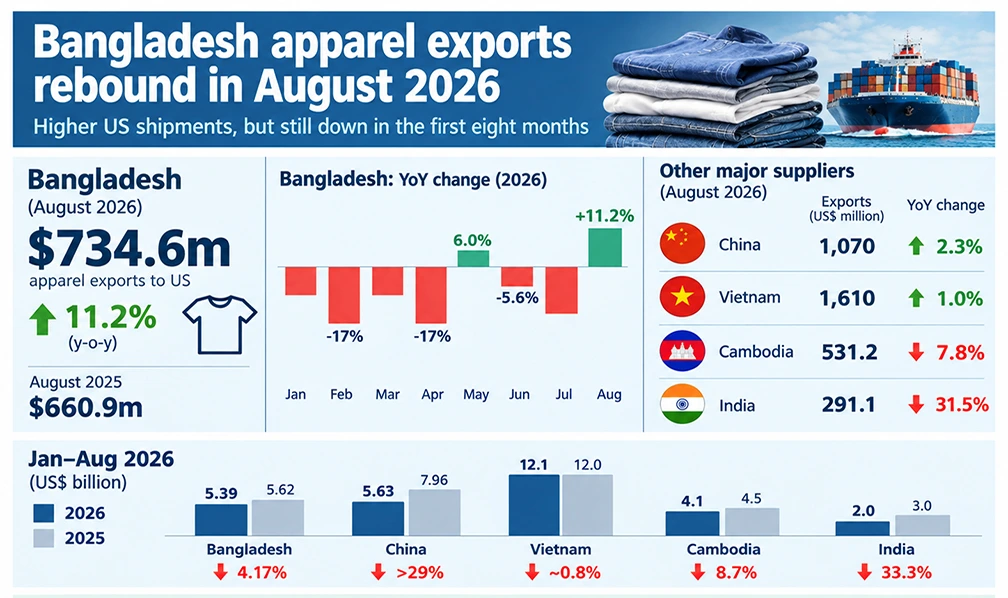
During the first five months of 2026, Bangladesh accounted for 11.3 per cent of US apparel imports by value, placing it second only to Vietnam, which held a 22.2 per cent share, while China’s share declined to 9.7 per cent.
Nearly 47 per cent of the surveyed companies reported that Bangladesh represented more than 10 per cent of their total sourcing value or volume, highlighting the country’s continued strategic importance to global buyers.
Despite these achievements, the report identified the speed to market as one of Bangladesh’s weakest competitive areas.
Bangladesh received a score of only 2.3 on 5 for speed to market, reflecting persistent logistical constraints and the country’s geographical distance from major consumer markets, it said.
While Bangladesh continued to excel in cost-efficient, large-scale production, its longer lead times became a competitive disadvantage as international retailers increasingly demanded faster inventory replenishment and shorter fashion cycles, findings suggested.
Despite the lower utilisation rate, the report presented an optimistic outlook for Bangladesh.
It ranked Bangladesh as the second most popular ‘rising star’ for future sourcing expansion, with 46.7 per cent of the respondents planning to increase sourcing from the country over the next two years, second only to Indonesia.
The report said that Bangladesh was expected to remain a dominant force in global apparel sourcing through 2028.
However, it said, sustaining that position would depend on the country’s ability to improve logistics, reduce lead times, strengthen domestic textile production, enhance labour and environmental compliance, and increase manufacturing flexibility while preserving its long-standing cost advantage.
The report also highlighted Bangladesh’s limited flexibility in accommodating smaller and specialised orders.
It said that Bangladesh had received a minimum order quantity score of 2.6, significantly below China’s leading score of 4.0.
According to the study, this indicated that Bangladesh remained primarily geared towards high-volume production of basic garments rather than smaller, more diverse production runs increasingly sought by international brands.
Vertical integration remained an area requiring improvement, the report also said.
Although Bangladesh scored 3.4 for vertical manufacturing capability, outperforming several competing countries, it continued to trail China, which scored 4.8, and India, which scored 4.0.
Most US fashion companies, the report said, still depended heavily on China for textile raw materials, including fabrics and accessories, increasing Bangladesh’s dependence on imported inputs and limiting its ability to shorten production lead times.
Bangladesh received a labour and social compliance score of 2.2 and an environmental compliance score of 2.4, placing it among the lower-performing sourcing destinations in these areas, it also said.
According to the report, improving traceability, labour standards, and environmental performance would be essential as international brands faced increasingly stringent regulatory requirements, including the Uyghur Forced Labor Prevention Act and emerging Extended Producer Responsibility laws.
The study found that Bangladesh was perceived as carrying a relatively high risk from future US import trade barriers, receiving a score of 2.2.
Unlike suppliers in the Western Hemisphere that benefited from preferential trade agreements, the survey noted, Bangladesh remained subject to standard tariff arrangements, increasing cost pressures at a time when protectionist trade policies were becoming a growing concern for apparel companies.
Respondents awarded Bangladesh a sourcing cost score of 4.3 on 5, tying it with China as the highest-rated sourcing destination for cost competitiveness.
The report said that Bangladesh’s established low-cost manufacturing base continued to provide international fashion brands with an effective hedge against rising global inflation and shipping costs.
According to the report, US fashion companies were moving away from the traditional concentration of orders in the three largest sourcing countries – China, Vietnam, and Bangladesh – and were increasingly distributing production across a wider range of markets to reduce geopolitical, regulatory, and supply chain risks.
During 2026, companies reported sourcing from 49 countries, up from 46 a year ago.
Emerging destinations such as Indonesia, Cambodia, Egypt, Jordan and Guatemala, the report said, were attracting increasing attention as buyers sought a more geographically balanced sourcing portfolio.
It said that imports from non-Asian countries had reached 15.8 per cent of the total US apparel imports, the highest level in more than a decade.
The report also said that buyers were consolidating rather than expanding their supplier networks.
Nearly half of the surveyed companies said that they planned to work with fewer suppliers over the next two years, preferring stronger strategic partnerships with vendors capable of providing greater traceability, compliance, and operational resilience.