9:23 pm, Thursday, 2 April 2026

Bangladesh RMG exports to US fall as tariffs curb demand

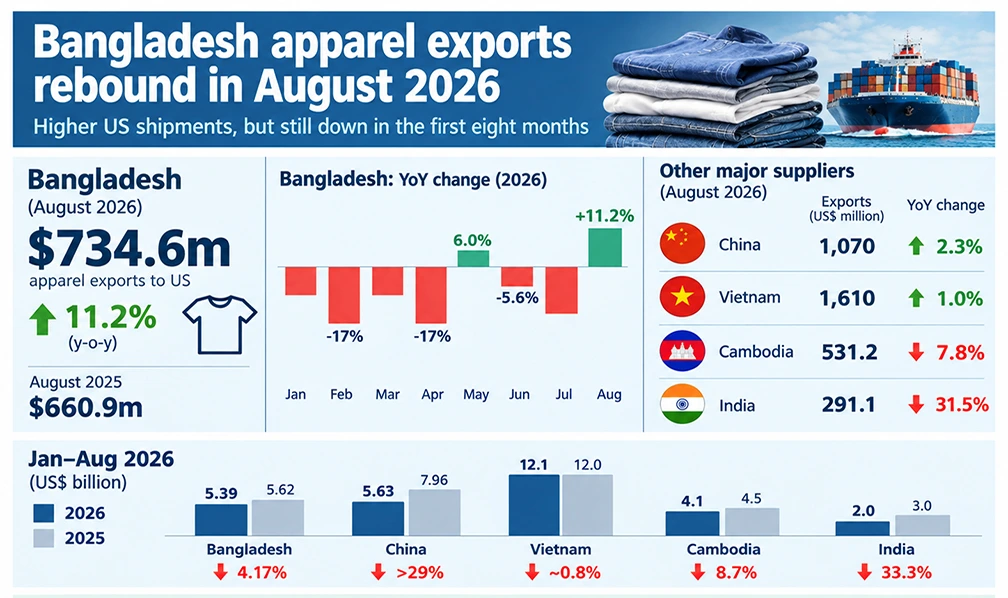
Bangladesh’s readymade garment (RMG) exports to its largest market, the United States, fell in both value and volume in November on a year-on-year basis, as higher tariffs weighed on demand and prompted buyers to change sourcing and ordering patterns.

Shipments to the US declined by 14.51 per cent to $526.51 million in November 2025, compared with $616.27 million in the same month a year earlier, according to the latest data from the US Office of Textiles and Apparel (Otexa), published on January 28.

This marked the second consecutive monthly fall.

In volume terms, Bangladesh exported 184.79 million square metres equivalent (SME) of apparel in November, down 10.91 per cent from 207.20 million SME a year earlier.

The downturn followed a similar trend in October, when exports fell by nearly 11 per cent to $647.73 million from $732.71 million in October 2024.

Earlier, in May, shipments had declined to $548.84 million from $596.67 million year on year.

Despite the recent slowdown, Bangladesh maintained double-digit growth in apparel exports to the US over the January–November period of 2025.

During the first eleven months of the year, exports rose by 12.44 per cent to $7.60 billion.

By contrast, overall US apparel imports contracted by 1.42 per cent during the same period, falling to $71.90 billion from $72.93 billion a year earlier.

In November alone, total US apparel imports declined sharply by 10.87 per cent in value and 14.36 per cent in volume.

China recorded the steepest fall among major suppliers, with US apparel imports from the country dropping by about 34 per cent to $10.06 billion during January-November, from $15.24 billion a year earlier.

Vietnam retained its position as the top supplier, posting growth of 11.38 per cent to $15.34 billion. India also expanded shipments by 6.06 per cent to $4.63 billion.

Cambodia registered the fastest growth, up 26.15 per cent, while Indonesia’s exports rose 9.80 per cent, earning $4.39 billion and $4.30 billion respectively.

Exporters said garment-producing countries, including Bangladesh, were grappling with the impact of the Trump administration’s reciprocal tariff measures, which have raised prices and dampened consumer demand in the US.

Under the new tariff regime introduced in August, Bangladeshi apparel products are subject to an additional 20 per cent duty, taking the total tariff to 36 per cent. Tariffs on Chinese and Indian products are even higher, contributing to a sharper fall in their exports.

Inamul Haq Khan, vice-president of the Bangladesh Garment Manufacturers and Exporters Association (BGMEA), said US consumption had weakened as high inflation pushed up the prices of goods.

Shovon Islam, managing director of Sparrow Group, said US buyers had cut work orders by 10 to 20 per cent due to higher tariffs, which had also reduced consumer demand.

The US accounts for around 70 per cent, or about Tk 20 billion, of his company’s total exports.

He said buyers were also changing their ordering patterns. Instead of placing large bulk orders of identical designs, they were making small changes in design, style or wash to add a fashion element and raise prices to absorb tariff costs.

‘Tariffs have forced them to move from general items to fashion products,’ he said, adding that Bangladesh, which largely produces basic items, had been hit harder.

Shovon expressed optimism that order volumes could recover after elections, noting that buyers had adopted a ‘wait-and-see’ approach between July and September to assess the tariff impact.

He also expected some orders, particularly higher-value, fashionable items, from China and India to shift to Bangladesh.

However, he stressed the need for a stable political environment and stronger banking support to boost exports.

Syed Arefin, managing director of American & Efird (Bangladesh), said some buyers had advanced shipments by July 2025 to avoid higher tariffs, which may have contributed to the subsequent decline in export earnings in both value and volume.

He said analysing both indicators together was essential to fully understand the tariff impact.

With the Christmas sales season over, buyers’ inventories were now close to depletion, and those who had cut back purchases were expected to begin placing new orders.

Fazlul Hoque, former president of the Bangladesh Knitwear Manufacturers and Exporters Association (BKMEA), said the fall in export volumes indicated that Bangladesh was not receiving the level of orders it had previously, reflecting a broader market downturn.

Some orders, he added, may have shifted to competitors such as Vietnam and India.

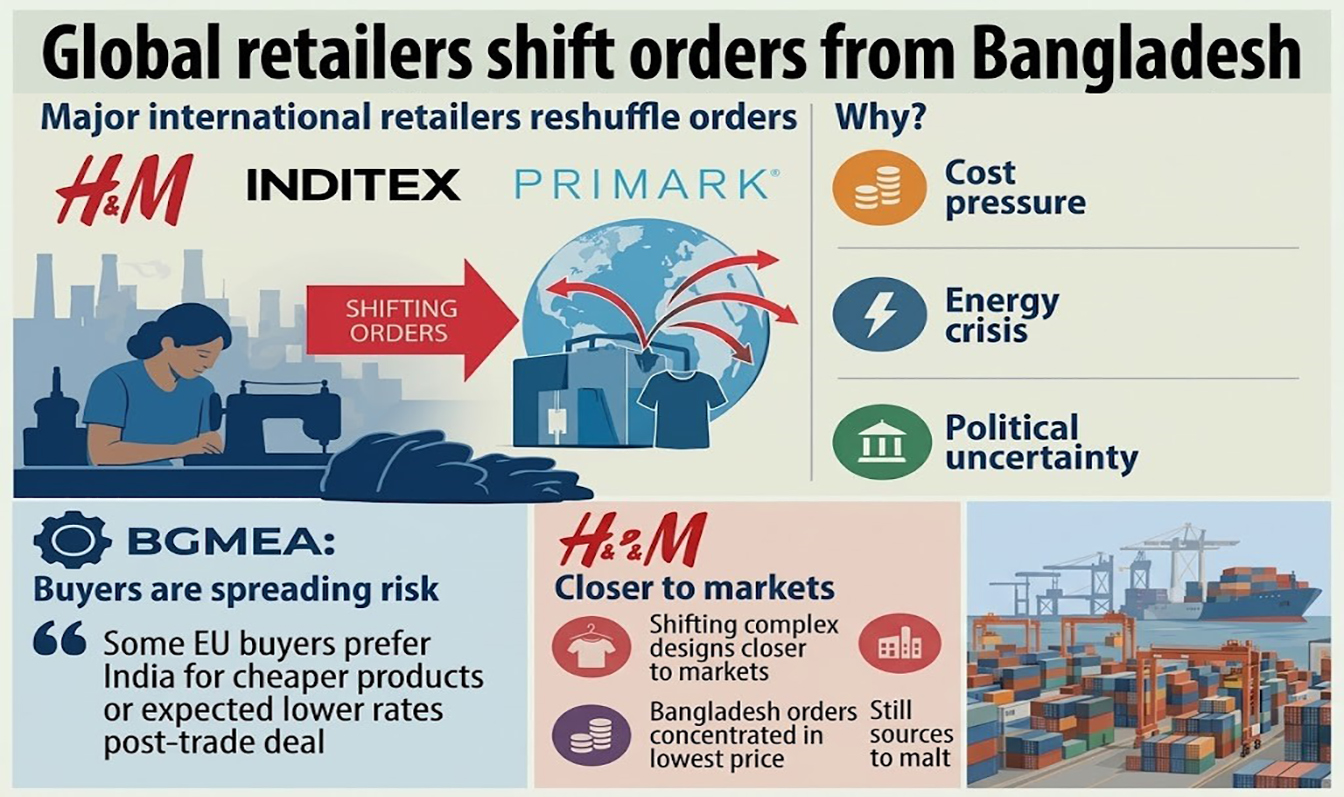
ABM Shamsuddin, chairman of Hannan Group, warned that due to high US tariffs, India and China were aggressively targeting the European Union market with lower-priced products, intensifying competition for Bangladesh, which has traditionally been strong in the EU.

He said the situation could worsen after India’s free trade agreement with the EU, which would give Indian exporters duty-free access.

Bangladesh, following its graduation from least developed country (LDC) status, is set to face duties of up to 12 per cent in the EU after the transition period ends in 2029.
Most Viewed

Bangladesh RMG exports to US fall as tariffs curb demand

Update Time : 03:12:15 am, Monday, 2 February 2026

Bangladesh’s readymade garment (RMG) exports to its largest market, the United States, fell in both value and volume in November on a year-on-year basis, as higher tariffs weighed on demand and prompted buyers to change sourcing and ordering patterns.

Shipments to the US declined by 14.51 per cent to $526.51 million in November 2025, compared with $616.27 million in the same month a year earlier, according to the latest data from the US Office of Textiles and Apparel (Otexa), published on January 28.

This marked the second consecutive monthly fall.

In volume terms, Bangladesh exported 184.79 million square metres equivalent (SME) of apparel in November, down 10.91 per cent from 207.20 million SME a year earlier.

The downturn followed a similar trend in October, when exports fell by nearly 11 per cent to $647.73 million from $732.71 million in October 2024.

Earlier, in May, shipments had declined to $548.84 million from $596.67 million year on year.

Despite the recent slowdown, Bangladesh maintained double-digit growth in apparel exports to the US over the January–November period of 2025.

During the first eleven months of the year, exports rose by 12.44 per cent to $7.60 billion.

By contrast, overall US apparel imports contracted by 1.42 per cent during the same period, falling to $71.90 billion from $72.93 billion a year earlier.

In November alone, total US apparel imports declined sharply by 10.87 per cent in value and 14.36 per cent in volume.

China recorded the steepest fall among major suppliers, with US apparel imports from the country dropping by about 34 per cent to $10.06 billion during January-November, from $15.24 billion a year earlier.

Vietnam retained its position as the top supplier, posting growth of 11.38 per cent to $15.34 billion. India also expanded shipments by 6.06 per cent to $4.63 billion.

Cambodia registered the fastest growth, up 26.15 per cent, while Indonesia’s exports rose 9.80 per cent, earning $4.39 billion and $4.30 billion respectively.

Exporters said garment-producing countries, including Bangladesh, were grappling with the impact of the Trump administration’s reciprocal tariff measures, which have raised prices and dampened consumer demand in the US.

Under the new tariff regime introduced in August, Bangladeshi apparel products are subject to an additional 20 per cent duty, taking the total tariff to 36 per cent. Tariffs on Chinese and Indian products are even higher, contributing to a sharper fall in their exports.

Inamul Haq Khan, vice-president of the Bangladesh Garment Manufacturers and Exporters Association (BGMEA), said US consumption had weakened as high inflation pushed up the prices of goods.

Shovon Islam, managing director of Sparrow Group, said US buyers had cut work orders by 10 to 20 per cent due to higher tariffs, which had also reduced consumer demand.

The US accounts for around 70 per cent, or about Tk 20 billion, of his company’s total exports.

He said buyers were also changing their ordering patterns. Instead of placing large bulk orders of identical designs, they were making small changes in design, style or wash to add a fashion element and raise prices to absorb tariff costs.

‘Tariffs have forced them to move from general items to fashion products,’ he said, adding that Bangladesh, which largely produces basic items, had been hit harder.

Shovon expressed optimism that order volumes could recover after elections, noting that buyers had adopted a ‘wait-and-see’ approach between July and September to assess the tariff impact.

He also expected some orders, particularly higher-value, fashionable items, from China and India to shift to Bangladesh.

However, he stressed the need for a stable political environment and stronger banking support to boost exports.

Syed Arefin, managing director of American & Efird (Bangladesh), said some buyers had advanced shipments by July 2025 to avoid higher tariffs, which may have contributed to the subsequent decline in export earnings in both value and volume.

He said analysing both indicators together was essential to fully understand the tariff impact.

With the Christmas sales season over, buyers’ inventories were now close to depletion, and those who had cut back purchases were expected to begin placing new orders.

Fazlul Hoque, former president of the Bangladesh Knitwear Manufacturers and Exporters Association (BKMEA), said the fall in export volumes indicated that Bangladesh was not receiving the level of orders it had previously, reflecting a broader market downturn.

Some orders, he added, may have shifted to competitors such as Vietnam and India.

ABM Shamsuddin, chairman of Hannan Group, warned that due to high US tariffs, India and China were aggressively targeting the European Union market with lower-priced products, intensifying competition for Bangladesh, which has traditionally been strong in the EU.

He said the situation could worsen after India’s free trade agreement with the EU, which would give Indian exporters duty-free access.

Bangladesh, following its graduation from least developed country (LDC) status, is set to face duties of up to 12 per cent in the EU after the transition period ends in 2029.