4:39 am, Monday, 16 March 2026

Family Card programme could lift 12m from poverty: RAPID

A newly piloted family card programme in Bangladesh has the potential to significantly reduce poverty if properly targeted, a study by Research and Policy Integration for Development (RAPID) has found.

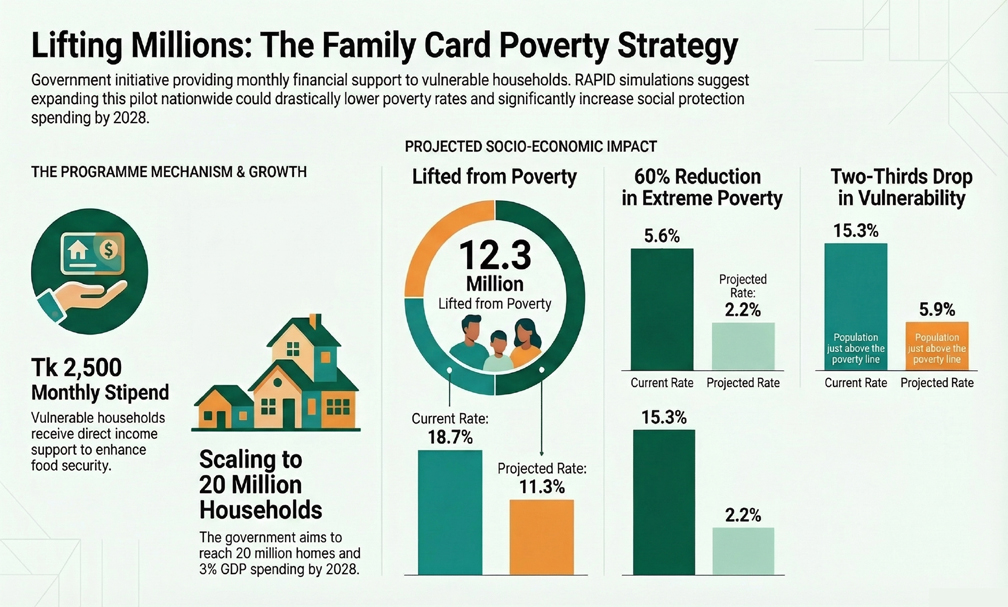
The initiative, introduced by the newly elected government, provides Tk 2,500 per month to more than 6,500 vulnerable households across 14 upazilas, aiming to enhance food security and income support.

Officials plan to gradually expand the scheme to 20 million households and raise social protection spending to 3 per cent of GDP by 2028.

Using simulations based on HIES 2022 data, the RAPID study suggests that providing Tk 2,500 monthly to all poor and vulnerable households could lower Bangladesh’s overall poverty rate from 18.7 per cent to 11.3 per cent-a 7.4 percentage-point decline.

Extreme poverty would fall from 5.6 per cent to 2.2 per cent, according to MA Razzaque, RAPID chairman, who presented the findings on March 12.

The roundtable discussion, moderated by RAPID executive director M Abu Eusuf at a Dhaka hotel, also highlighted the programme’s impact on the vulnerable population—those within 25 per cent above the poverty line—which would fall from 15.3 per cent to 5.9 per cent, a reduction of two-thirds.

In absolute terms, full coverage under the Family Card could lift 12.3 million people out of poverty and reduce the number of extremely poor by 5.6 million.

Currently, 56.4 million people are considered vulnerable; this number would drop to 40.8 million under the proposed scheme.

Razzaque emphasised that a reversal in poverty reduction gains underscores the need for targeted income support.

Persistently high inflation, weak economic activity, and the widening gap between wages and living costs have eroded real incomes, weakening the resilience of low-income households.

He noted that the absence of a predictable, poverty-targeted income support system has left more than half of poor and vulnerable households without benefits.

‘Strong political commitment, even within extremely limited fiscal space, is indispensable for developing a modern and effective social protection system, including social insurance schemes for workers,’ he said.

Mohammad Abu Yusuf, secretary of the Ministry of Social Welfare, assured that the government would address concerns raised at the roundtable, including targeting, fiscal space, and data accuracy.

He explained that data collection is being conducted door-to-door through proxy means testing (PMT), though challenges remain, such as reports of families receiving cards despite owning multi-storey homes.

Shah Mohammad Mahbub, director general of the Department of Social Services, highlighted the programme’s non-economic impact, including enhancing public trust in government support.

Speakers stressed the importance of data availability, consolidation across existing social protection schemes, reducing inclusion errors, and the role of NGOs in verification processes.

They also underscored that a robust workers’ database is critical for implementing an effective social protection agenda.

RAPID recommended positioning the Family Card as a potential anchor for a more coherent and effective social protection framework, carefully designed to avoid deepening fragmentation or adding undue fiscal pressure.

Family Card programme could lift 12m from poverty: RAPID

Update Time : 12:26:32 am, Friday, 13 March 2026

A newly piloted family card programme in Bangladesh has the potential to significantly reduce poverty if properly targeted, a study by Research and Policy Integration for Development (RAPID) has found.

The initiative, introduced by the newly elected government, provides Tk 2,500 per month to more than 6,500 vulnerable households across 14 upazilas, aiming to enhance food security and income support.

Officials plan to gradually expand the scheme to 20 million households and raise social protection spending to 3 per cent of GDP by 2028.

Using simulations based on HIES 2022 data, the RAPID study suggests that providing Tk 2,500 monthly to all poor and vulnerable households could lower Bangladesh’s overall poverty rate from 18.7 per cent to 11.3 per cent-a 7.4 percentage-point decline.

Extreme poverty would fall from 5.6 per cent to 2.2 per cent, according to MA Razzaque, RAPID chairman, who presented the findings on March 12.

The roundtable discussion, moderated by RAPID executive director M Abu Eusuf at a Dhaka hotel, also highlighted the programme’s impact on the vulnerable population—those within 25 per cent above the poverty line—which would fall from 15.3 per cent to 5.9 per cent, a reduction of two-thirds.

In absolute terms, full coverage under the Family Card could lift 12.3 million people out of poverty and reduce the number of extremely poor by 5.6 million.

Currently, 56.4 million people are considered vulnerable; this number would drop to 40.8 million under the proposed scheme.

Razzaque emphasised that a reversal in poverty reduction gains underscores the need for targeted income support.

Persistently high inflation, weak economic activity, and the widening gap between wages and living costs have eroded real incomes, weakening the resilience of low-income households.

He noted that the absence of a predictable, poverty-targeted income support system has left more than half of poor and vulnerable households without benefits.

‘Strong political commitment, even within extremely limited fiscal space, is indispensable for developing a modern and effective social protection system, including social insurance schemes for workers,’ he said.

Mohammad Abu Yusuf, secretary of the Ministry of Social Welfare, assured that the government would address concerns raised at the roundtable, including targeting, fiscal space, and data accuracy.

He explained that data collection is being conducted door-to-door through proxy means testing (PMT), though challenges remain, such as reports of families receiving cards despite owning multi-storey homes.

Shah Mohammad Mahbub, director general of the Department of Social Services, highlighted the programme’s non-economic impact, including enhancing public trust in government support.

Speakers stressed the importance of data availability, consolidation across existing social protection schemes, reducing inclusion errors, and the role of NGOs in verification processes.

They also underscored that a robust workers’ database is critical for implementing an effective social protection agenda.

RAPID recommended positioning the Family Card as a potential anchor for a more coherent and effective social protection framework, carefully designed to avoid deepening fragmentation or adding undue fiscal pressure.