4:42 am, Monday, 16 March 2026

EU buyers pay more for Bangladeshi apparel than in US: study

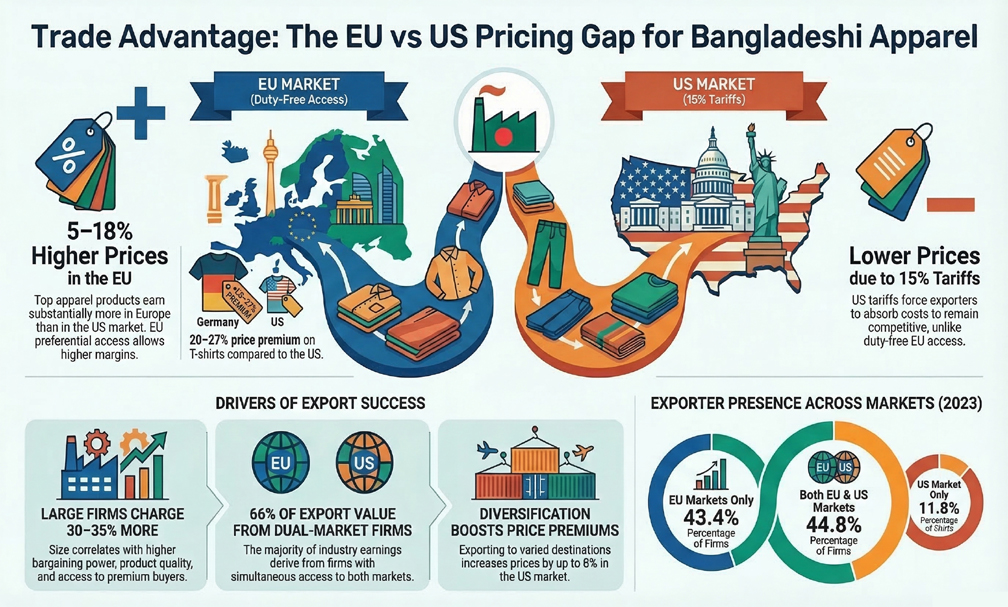
Bangladeshi garments are securing substantial price premiums in the European Union than in the United States, as exporters leverage preferential market access and strategic pricing, according to a new study by the Research and Policy Integration for Development (RAPID).

‘On average, firms exporting the top ten apparel products obtain between 5 and 18 per cent higher prices in the EU than in the US market,’ said Jillur Rahman, lecturer in the Department of Development Studies at Dhaka University and RAPID’s deputy director.

He cited examples including T-shirts, which earn exporters approximately 20 to 27 per cent higher prices in Germany than in the US, while trousers command a 9 to 15 per cent premium in the German market.

The study attributed this systematic price differential to destination-specific pricing behaviour, reflecting the advantages offered by preferential EU access compared with non-preferential US markets.

Under the EU’s Everything But Arms (EBA) initiative, Bangladeshi exports enjoy duty-free access, whereas the United States applies Most Favoured Nation (MFN) tariffs averaging 12–15 per cent, with no comparable preference.

Jillu presented the study, titled ‘Navigating Post-LDC Graduation: Firm-level Evidence on Export Pricing Strategies in Bangladesh’s RMG Sector in Preferential vs Non-Preferential Markets,’ at a consultation event held on March 14 in the Department of Development Studies conference room at Dhaka University.

The event was moderated by RAPID executive director Muhammad Abu Eusuf and attended by commerce ministry additional secretary Abdur Rahim Khan, acting Dean of DU’s Faculty of Social Sciences Taiabur Rahman, Export Promotion Bureau director general Md Ruhul Amin, and Economic Reporters’ Forum president Doulot Akter Mala.

Bangladeshi apparel exporters adopt markedly different pricing strategies across preferential and non-preferential markets, Jillu noted, adding that firms charge on average more than 10 per cent lower prices in the US than in the EU.

‘High US tariffs compel exporters to absorb a significant share of the tax burden within their own margins to remain price-competitive at the border,’ he explained.

The study also found incomplete exchange-rate pass-through, with exporters absorbing around 55 per cent of currency depreciation when exporting to the US, compared with roughly 40 per cent for the EU.

This suggests that firms operating in non-preferential US markets have stronger incentives to retain exchange-rate gains in local-currency margins rather than pass them fully into lower export prices.

Bangladesh Customs data cited in the study showed that in 2023, 43.4 per cent of firms exported exclusively to the EU, 11.8 per cent to the US, and the remaining 44.8 per cent to both destinations.

Firms exporting to both markets accounted for over 66 per cent of total apparel export value, indicating that most earnings derive from firms with simultaneous market access.

Firm-level characteristics also influence export pricing, with large firms charging 30–35 per cent higher prices than small and medium-sized exporters across both markets, reflecting greater bargaining power, higher product quality, and access to premium buyers.

This advantage is particularly pronounced in the US market.

Firms exporting to more diversified destinations obtain higher price premiums, 1-3 per cent in the EU and 5-8 per cent in the US, while knitwear-focused exporters receive 10-13 per cent lower prices, reflecting lower unit values.

Technological intensity, by contrast, does not significantly affect export prices, indicating its primary role is in cost efficiency and volume expansion rather than pricing.

The study highlighted the role of product diversification in shaping pricing strategies.

Single-product exporters showed no significant difference between EU and US prices, suggesting a limited ability to adjust mark-ups, while multi-product firms demonstrated greater flexibility to differentiate prices across markets.

This distinction underscored the vulnerability of single-product exporters and the strategic resilience of multi-product firms.

Abdur Rahim Khan emphasised the need for export-led investment to enhance both technology and capital.

He noted that Bangladesh remained largely dependent on cotton-based garments, while global demand was shifting towards non-cotton or manmade fibre apparel.

Discussing post-LDC graduation, he indicated that Bangladesh might receive a three-year extension and urged firms to prepare strategically.

Speakers at the event recommended that firms pursue product and market diversification, negotiate free trade agreements, develop local design and branding, and focus on high value-added items to tackle post-graduation challenges.

EU buyers pay more for Bangladeshi apparel than in US: study

Update Time : 01:00:41 am, Sunday, 15 March 2026

Bangladeshi garments are securing substantial price premiums in the European Union than in the United States, as exporters leverage preferential market access and strategic pricing, according to a new study by the Research and Policy Integration for Development (RAPID).

‘On average, firms exporting the top ten apparel products obtain between 5 and 18 per cent higher prices in the EU than in the US market,’ said Jillur Rahman, lecturer in the Department of Development Studies at Dhaka University and RAPID’s deputy director.

He cited examples including T-shirts, which earn exporters approximately 20 to 27 per cent higher prices in Germany than in the US, while trousers command a 9 to 15 per cent premium in the German market.

The study attributed this systematic price differential to destination-specific pricing behaviour, reflecting the advantages offered by preferential EU access compared with non-preferential US markets.

Under the EU’s Everything But Arms (EBA) initiative, Bangladeshi exports enjoy duty-free access, whereas the United States applies Most Favoured Nation (MFN) tariffs averaging 12–15 per cent, with no comparable preference.

Jillu presented the study, titled ‘Navigating Post-LDC Graduation: Firm-level Evidence on Export Pricing Strategies in Bangladesh’s RMG Sector in Preferential vs Non-Preferential Markets,’ at a consultation event held on March 14 in the Department of Development Studies conference room at Dhaka University.

The event was moderated by RAPID executive director Muhammad Abu Eusuf and attended by commerce ministry additional secretary Abdur Rahim Khan, acting Dean of DU’s Faculty of Social Sciences Taiabur Rahman, Export Promotion Bureau director general Md Ruhul Amin, and Economic Reporters’ Forum president Doulot Akter Mala.

Bangladeshi apparel exporters adopt markedly different pricing strategies across preferential and non-preferential markets, Jillu noted, adding that firms charge on average more than 10 per cent lower prices in the US than in the EU.

‘High US tariffs compel exporters to absorb a significant share of the tax burden within their own margins to remain price-competitive at the border,’ he explained.

The study also found incomplete exchange-rate pass-through, with exporters absorbing around 55 per cent of currency depreciation when exporting to the US, compared with roughly 40 per cent for the EU.

This suggests that firms operating in non-preferential US markets have stronger incentives to retain exchange-rate gains in local-currency margins rather than pass them fully into lower export prices.

Bangladesh Customs data cited in the study showed that in 2023, 43.4 per cent of firms exported exclusively to the EU, 11.8 per cent to the US, and the remaining 44.8 per cent to both destinations.

Firms exporting to both markets accounted for over 66 per cent of total apparel export value, indicating that most earnings derive from firms with simultaneous market access.

Firm-level characteristics also influence export pricing, with large firms charging 30–35 per cent higher prices than small and medium-sized exporters across both markets, reflecting greater bargaining power, higher product quality, and access to premium buyers.

This advantage is particularly pronounced in the US market.

Firms exporting to more diversified destinations obtain higher price premiums, 1-3 per cent in the EU and 5-8 per cent in the US, while knitwear-focused exporters receive 10-13 per cent lower prices, reflecting lower unit values.

Technological intensity, by contrast, does not significantly affect export prices, indicating its primary role is in cost efficiency and volume expansion rather than pricing.

The study highlighted the role of product diversification in shaping pricing strategies.

Single-product exporters showed no significant difference between EU and US prices, suggesting a limited ability to adjust mark-ups, while multi-product firms demonstrated greater flexibility to differentiate prices across markets.

This distinction underscored the vulnerability of single-product exporters and the strategic resilience of multi-product firms.

Abdur Rahim Khan emphasised the need for export-led investment to enhance both technology and capital.

He noted that Bangladesh remained largely dependent on cotton-based garments, while global demand was shifting towards non-cotton or manmade fibre apparel.

Discussing post-LDC graduation, he indicated that Bangladesh might receive a three-year extension and urged firms to prepare strategically.

Speakers at the event recommended that firms pursue product and market diversification, negotiate free trade agreements, develop local design and branding, and focus on high value-added items to tackle post-graduation challenges.