4:42 am, Monday, 16 March 2026

Bangladesh faces US scrutiny over export-led overcapacity

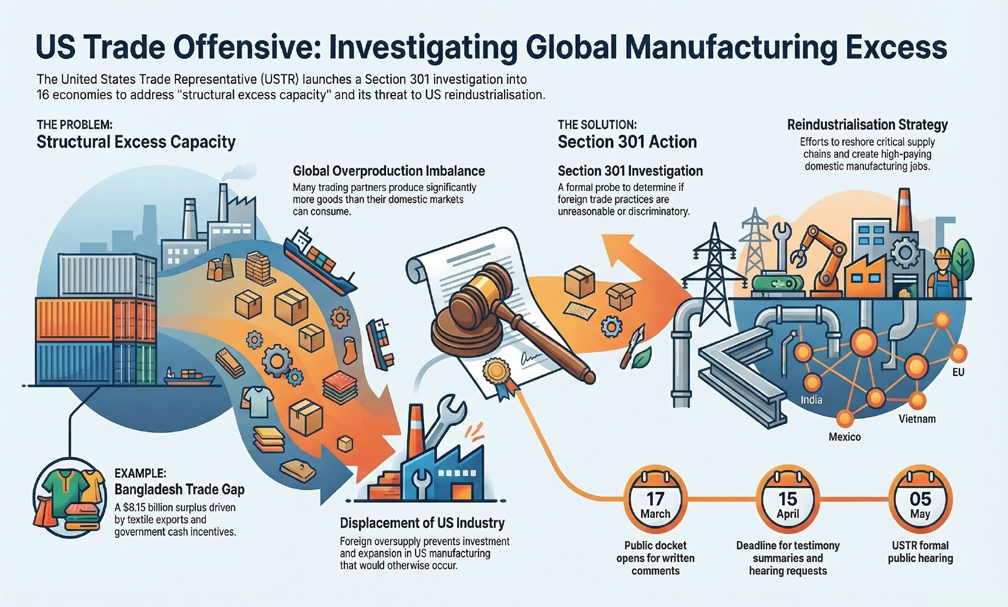
The Office of the United States Trade Representative (USTR) has launched a new trade investigation into the manufacturing sectors of 16 economies, including Bangladesh, citing concerns that structural excess capacity and overproduction abroad are undermining efforts to rebuild the American industrial base.

The other economies under investigation are China, the European Union, India, Vietnam, Indonesia, Malaysia, Thailand, Cambodia, South Korea, Japan, Mexico, Singapore, Switzerland, Norway and Taiwan.

In a statement issued on March 11, Jamieson Greer, the United States Trade Representative, announced the initiation of investigations under Section 301(b) of the Trade Act of 1974.

The probe will examine whether the acts, policies and practices of these economies relating to excess capacity and production in manufacturing sectors are unreasonable or discriminatory, and whether they burden or restrict US commerce.

Mr Greer said the investigations reflected the administration’s determination to strengthen domestic industry.

‘The United States will no longer sacrifice its industrial base to other countries that may be exporting their problems with excess capacity and production to us. Today’s investigations underscore President Donald Trump’s commitment to reshore critical supply chains and create good-paying jobs for American workers across our manufacturing sectors,’ he said.

According to Mr Greer, the administration’s reindustrialisation efforts continue to face significant challenges due to structural excess capacity in foreign economies.

‘Across numerous sectors, many US trading partners are producing more goods than they can consume domestically,’ he said, adding that such overproduction can displace existing US production or discourage investment in domestic manufacturing.

He said that in many sectors the United States had lost substantial domestic production capacity or had fallen worryingly behind foreign competitors.

According to a notice published in the Federal Register, the allegation concerning Bangladesh centres on government cash incentives provided to 43 export-oriented sectors, including domestic textile and leather products.

The notice says these incentives have contributed to a multi-billion-dollar bilateral trade gap with the United States in Bangladesh’s favour.

The notice said that evidence of structural excess capacity and production existed for Bangladesh, which had a bilateral goods trade surplus of $6.15 billion with the United States, led primarily by exports from the textiles sector.

The document also noted that Bangladesh’s cement industry is facing significant excess capacity amid what it described as the sector’s worst downturn in years.

National cement consumption fell to about 38 million tonnes in 2024—less than 40 per cent of total capacity—and is expected to decline further in 2025.

The USTR said a public docket for comments on the investigations will open on March 17.

Interested parties must submit written comments, requests to appear at the hearing and summaries of testimony by April 15.

A public hearing on the matter is scheduled for May 5.

Bangladesh faces US scrutiny over export-led overcapacity

Update Time : 01:00:50 am, Friday, 13 March 2026

The Office of the United States Trade Representative (USTR) has launched a new trade investigation into the manufacturing sectors of 16 economies, including Bangladesh, citing concerns that structural excess capacity and overproduction abroad are undermining efforts to rebuild the American industrial base.

The other economies under investigation are China, the European Union, India, Vietnam, Indonesia, Malaysia, Thailand, Cambodia, South Korea, Japan, Mexico, Singapore, Switzerland, Norway and Taiwan.

In a statement issued on March 11, Jamieson Greer, the United States Trade Representative, announced the initiation of investigations under Section 301(b) of the Trade Act of 1974.

The probe will examine whether the acts, policies and practices of these economies relating to excess capacity and production in manufacturing sectors are unreasonable or discriminatory, and whether they burden or restrict US commerce.

Mr Greer said the investigations reflected the administration’s determination to strengthen domestic industry.

‘The United States will no longer sacrifice its industrial base to other countries that may be exporting their problems with excess capacity and production to us. Today’s investigations underscore President Donald Trump’s commitment to reshore critical supply chains and create good-paying jobs for American workers across our manufacturing sectors,’ he said.

According to Mr Greer, the administration’s reindustrialisation efforts continue to face significant challenges due to structural excess capacity in foreign economies.

‘Across numerous sectors, many US trading partners are producing more goods than they can consume domestically,’ he said, adding that such overproduction can displace existing US production or discourage investment in domestic manufacturing.

He said that in many sectors the United States had lost substantial domestic production capacity or had fallen worryingly behind foreign competitors.

According to a notice published in the Federal Register, the allegation concerning Bangladesh centres on government cash incentives provided to 43 export-oriented sectors, including domestic textile and leather products.

The notice says these incentives have contributed to a multi-billion-dollar bilateral trade gap with the United States in Bangladesh’s favour.

The notice said that evidence of structural excess capacity and production existed for Bangladesh, which had a bilateral goods trade surplus of $6.15 billion with the United States, led primarily by exports from the textiles sector.

The document also noted that Bangladesh’s cement industry is facing significant excess capacity amid what it described as the sector’s worst downturn in years.

National cement consumption fell to about 38 million tonnes in 2024—less than 40 per cent of total capacity—and is expected to decline further in 2025.

The USTR said a public docket for comments on the investigations will open on March 17.

Interested parties must submit written comments, requests to appear at the hearing and summaries of testimony by April 15.

A public hearing on the matter is scheduled for May 5.