Bizbd Report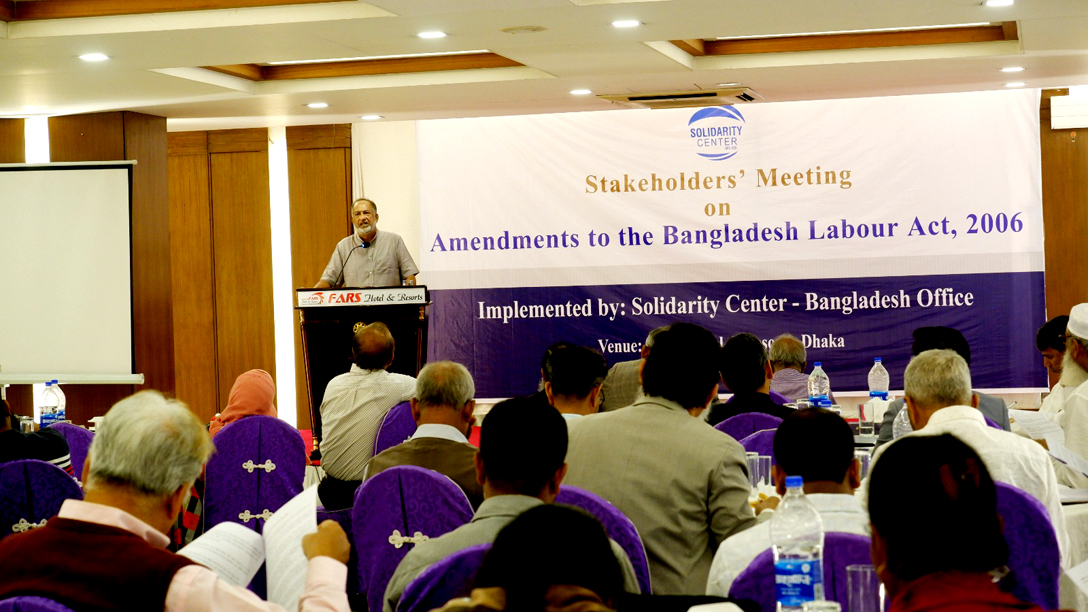
A stakeholders’ meeting on proposed amendments to the Bangladesh Labour Act, 2006, highlighted gaps in the latest changes and its potential impact on workers.
The discussion, organised by the Solidarity Center on Thursday at a city hotel, brought together labour rights advocates, employers, and policymakers to review the amendments and ensure they fairly reflect the interests of all parties.
Participants said several proposals, including freedom of association and collective bargaining suggested by the Tripartite Consultative Committee, especially from workers’ representatives, were not included in the latest amendments.
They warned that in some cases, the changes might give disproportionate advantages to employers.
Some participants welcomed certain changes. These include revising the minimum wage every three years instead of five.
However, labour rights defenders mentioned that recommendations from the Labour Reform Commission were not fully incorporated into the amendments.
Solidarity Center country programme director AKM Nasim, pointed out technical inconsistencies in the amended law.
He cited examples in union formation rules. Under clause (a), a union in a 300-worker establishment requires 20 members, about 6.7 per cent of the workforce.
But if the establishment has 301 workers, the required number jumps to 40, or 13.3 per cent, under clause (b).
Similarly, for 500 workers, the threshold is 40 members (8 per cent), but adding one worker increases the requirement to 100 members (nearly 20 per cent) under clause (c).
Nasim said such abrupt jumps could undermine the law’s goal of facilitating union formation.
He warned that although the amendment appeared sound in theory, loopholes would emerge over time.
Taslima Akter, a member of the LRC, emphasised that workers’ voices were often ignored, a trend she said was also evident in the TCC.
She welcomed the revision of the minimum wage every three years but pointed out that buyers’ accountability had not been addressed.
Bangladesh Knitwear Manufacturers and Exporters Association president Mohammed Hatem said that the government had ignored the TCC’s recommendations on collective bargaining agents and workers’ representation thresholds for forming trade unions.
He, however, welcomed the three-year wage revision provision but suggested annual adjustments for inflation and living costs would benefit both workers and employers.
Former Labour Reform Commission chairman Syed Sultan Uddin Ahmmed highlighted the complexities of amending a codified law.
He said only Bangladesh and the Philippines have such codified labour laws, and inconsistencies often arise when amendments are made.
He recommended analysing the law in its entirety and taking a wider view beyond the RMG sector.
Labour Ministry Deputy Secretary Shamsul Alam, representing the government, stressed the importance of tripartite collaboration in implementing the labour law amendments.
He said the amendment was possible due to contributions from all participants and called for both workers and employers to work together in a tripartite capacity.
Shamsul also pledged to elevate the discussion within the ministry, noting that he would share the suggestions provided by the Solidarity Center for further consideration in the amendment process.