Bizbd Report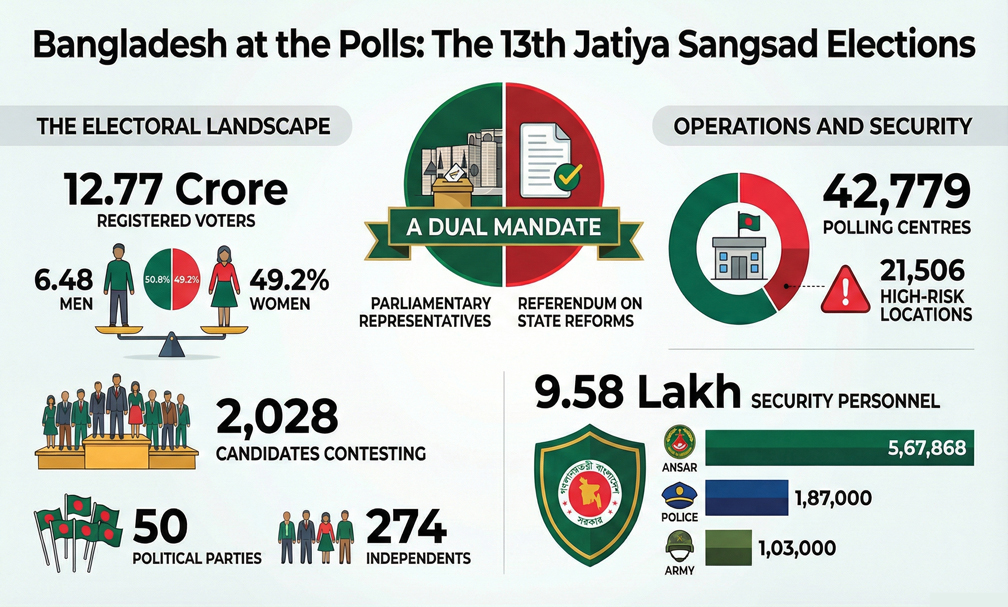
Bangladesh is voting today in its 13th Jatiya Sangsad election, held simultaneously with a nationwide referendum on whether citizens support a package of state reforms known as the ‘July National Charter’.
Polling is under way in 299 of the country’s 300 constituencies, after voting in Sherpur-3 was postponed following the death of a candidate.
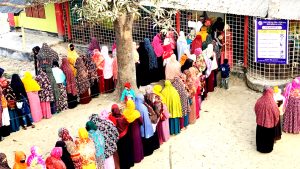
Balloting began at 7:30am and will continue until 4:30pm, with officials instructed to ensure that no voter is prevented from casting a ballot due to time constraints.
A total of 2,028 candidates from 50 political parties are contesting the parliamentary election, alongside 274 independents.
Among them are 41 women contenders. Although 60 parties are registered with the Election Commission (EC), not all have fielded candidates.
The Bangladesh Nationalist Party has nominated the highest number of candidates at 291. Islami Andolon Bangladesh has fielded 258, Jamaat-e-Islami 228 and the Jatiya Party 198.
The EC said the level of participation reflected a competitive electoral landscape.
According to official data, there are 12.77 crore registered voters, including approximately 6.48 crore men and 6.28 crore women.
Nearly 45 per cent are aged between 18 and 33, underscoring a significant youth presence.
Around four crore young voters are participating, many casting ballots in a general election for the first time.
The poll is being held under an interim administration formed after the political upheaval of 2024.
The Awami League government led by Sheikh Hasina, in power from 2009 until August 4, 2024 following a series of disputed elections, was toppled in a student-led mass uprising on August 5.
An interim government headed by Professor Muhammad Yunus assumed office on August 8, 2024.
Shortly afterwards, it banned the activities of the Awami League over allegations of crimes against humanity during the July–August unrest. The Election Commission subsequently suspended the party’s registration, rendering it ineligible to contest the current election.
The interim administration has pledged sweeping state reforms, accountability for the 2024 violence and the holding of a credible national poll. For many voters who felt excluded from the previous three general elections in 2014, 2018 and 2024, the vote is seen as an opportunity to reclaim their democratic rights.
Millions of young and previously disillusioned citizens are also expected to participate in what many view as a defining political moment.
In a first for a national election, expatriate Bangladeshis have cast ballots by post.
Voting is taking place at 42,958 centres across the country.
Of these, 42,659 are designated for in-person voting, while 299 are assigned to count postal ballots.
The EC has identified around half of the in-person polling stations as sensitive, based on local risk assessments.\
Security has been tightened nationwide, with around 9.58 lakh law enforcement personnel deployed.
More than 2,100 executive magistrates and 657 judicial magistrates are on duty to address electoral and legal violations.
The commission said there was no cause for alarm given the scale of preparations, although isolated incidents could not be ruled out.
For the first time in a national poll, unmanned aerial vehicles are being used to monitor voting areas.
Law enforcement officers have been equipped with body-worn cameras, while more than 90 per cent of polling centres are fitted with CCTV cameras.
The election is being administered by 69 returning officers, over 900 assistant returning officers, 4,378 presiding officers, 247,862 assistant presiding officers and more than five lakh polling officers.
At least 394 international observers and 197 foreign journalists are in the country to monitor the election and the referendum.
A central feature of the day’s vote is the referendum on the July National Charter (Constitutional Reform) Implementation Order, 2025.
If a majority backs the proposal, a constitutional reform council comprising elected members of the new parliament will be formed.
The council will function alongside the Jatiya Sangsad and will have 180 working days from its first sitting to finalise specific constitutional changes.
The reforms adopted by the council will be final and will not require further approval.
Within 30 working days of completing its task, a 100-member upper house will be constituted on the basis of each party’s vote share in the election and will serve for the duration of the lower house’s term.
The ousted Awami League government faced sustained criticism over the general elections held in 2014, 2018 and 2024.
An investigation committee appointed by the interim administration concluded that those polls were not isolated events but part of a long-term strategy to retain power following the abolition of the caretaker government system through the 15th constitutional amendment in 2011.
According to the committee, the amendment enabled a series of one-sided and engineered elections, culminating in the 10th, 11th and 12th Jatiya Sangsad polls in 2014, 2018 and 2024.
The 2014 election was marked by boycotts, violence and 153 candidates being elected unopposed. International observers, including the US State Department and the Commonwealth, cited serious irregularities.
In 2018, opposition parties participated but, according to the report, faced widespread arrests and legal pressure.
The 2024 election was again boycotted by major opposition forces and was alleged to have relied on so-called dummy candidates to create an appearance of competition.
Findings referenced from the European Union Election Expert Mission pointed to manipulation and tactics designed to secure victory for the ruling party.