Bizbd Report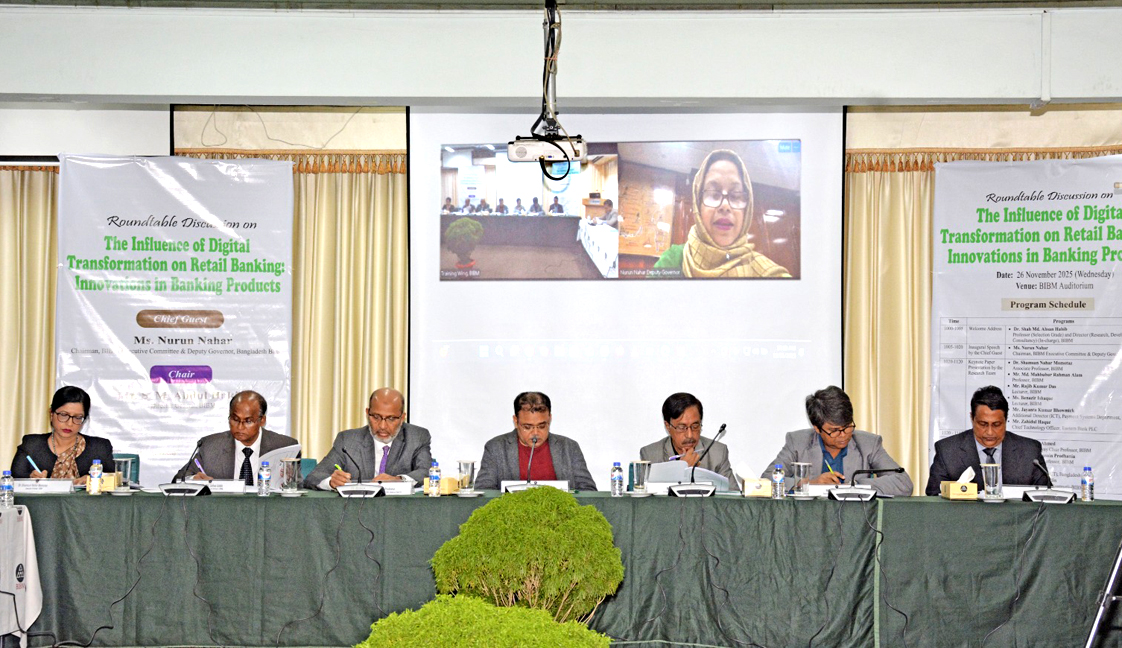
Around 75 per cent of financial service customers in Bangladesh still remained outside the reach of digital banking services, according to a Bangladesh Institute of Bank Management (BIBM) study, which highlighted a significant gap in digital adoption across the country’s banking sector.
The report stated that only 24.24 per cent of the total customer base currently used at least one digital banking product, such as mobile apps or internet banking.
Experts cited high costs, cybersecurity threats, and a knowledge gap as major barriers to wider digital adoption.
Titled ‘The Influence of Digital Transformation on Retail Banking: Innovations in Banking Products,’ the study examined 32 banks and 320 customer interviews.
In the financial year 2024-25, the total number of accounts reached 418.90 million, reflecting rapid digital transformation in the banking sector, it noted.
Among account holders, 40.34 per cent are deposit clients, and 34.76 per cent use mobile financial services, excluding Nagad users.
Other users include MFS agents, debit and credit card holders, and customers using banking apps or internet banking platforms.
BIBM professors Md Mahbubur Rahman Alam and Shamsun Nahar Momotaz presented the findings at a roundtable in Dhaka on Thursday.
Speakers at the event included Faruq M Ahmed, Md Ali Hossain Prodhania, Julhas Uddin, and Bangladesh Bank Executive Director (ICT) Julhas Uddin.
Deputy Governor of Bangladesh Bank Nurun Nahar said the sector faces major systemic challenges needing immediate collaborative action to achieve digital maturity.
High technology and infrastructure costs, coupled with cybersecurity threats, remain the most formidable barriers to wider digital adoption, she added.
Currently, 68.50 per cent of banks are in ‘Stage 2: Evolving and In Progress,’ with siloed systems limiting integrated digital services.
This lack of maturity, coupled with operational failings, has created a significant customer satisfaction gap, with nearly half (48 per cent) of customers dissatisfied or neutral due to issues such as unreliable systems, she noted.
This lack of maturity and operational failures cause nearly half of customers to feel dissatisfied or neutral about banking services.
A key obstacle to mass adoption is the knowledge and literacy gap, affecting 23.2 per cent of potential digital banking users, the report said.
Over the past decade, banking delivery channels surged to 1.6 million, with MFS agents accounting for 88.27 per cent of total delivery points by 2025.
Mobile banking apps are the most used channel at 81.62 per cent, followed by ATMs, used by 72.90 per cent of respondents.
Smartphones dominate digital banking access, accounting for 71.21 per cent of all users, highlighting technology’s central role in sector transformation.